9 min read
Tempered Glass Aluminum Windows: A Complete B2B Guide to Strength, Safety & Custom Manufacturing
When a project calls for windows that must withstand high wind loads, resist impact, and deliver decades of reliable service, the combination of tempered glass and aluminum framing is the engineering answer. As a professional manufacturer at Jusen Doors & Windows Manufacturing Co., Ltd., we have spent over 20 years processing aluminum and wood for global construction projects. We have seen firsthand how the right window specification protects a building envelope—and how the wrong sourcing decision can delay a timeline or compromise safety.
This guide is written from our factory floor perspective. We will walk you through why tempered glass aluminum windows are the industry standard, how we manufacture them in our own workshops, and what you should expect from a manufacturing partner who handles your project from raw material to export packaging.
Why Tempered Glass is the Industry Standard for Aluminum Window Systems
Tempered glass is not a luxury upgrade—it is a structural necessity for modern aluminum window systems. Our engineering team evaluates every project’s wind load, building height, and local safety codes before recommending a glass configuration. Here is the technical reality behind the specification.
The Physics of Strength: Heat Treatment and Impact Resistance
The tempering process involves heating glass to approximately 620°C (1,150°F) and then rapidly cooling it with forced air. This thermal treatment creates a state of high surface compression and internal tension. The result is glass that is four to five times stronger than standard annealed glass of the same thickness [1].
For high-rise buildings and coastal regions prone to typhoons or hurricanes, this strength differential is critical. A standard 6mm annealed pane may fracture under a specific wind load, while a 6mm tempered pane will withstand the same force without issue. When we review project specifications, our engineers calculate the required glass thickness based on your region’s wind zone map—ensuring you neither over-spec (wasting budget) nor under-spec (creating liability).
Safety First: How Tempered Glass Reduces Liability on Construction Sites
When tempered glass does break, it shatters into small, granular chunks rather than jagged shards. This “spider-web” granulation pattern significantly reduces the risk of severe laceration injuries. For contractors and developers, this is a liability issue as much as a safety feature.
On a construction site, workers handle and install these units daily. A window that breaks into dangerous shards during installation creates immediate injury risk and potential legal exposure. Our engineering team factors this into every recommendation, and our production line inspects each pane for edge damage before assembly—because a compromised edge can cause spontaneous breakage during handling.
Aluminum Frames vs. Other Materials: Why We Pair Them with Tempered Glass
Tempered glass is heavy. A single square meter of 6mm glass weighs approximately 15 kilograms. Your frame system must support that weight without sagging, twisting, or deforming over time. This is where aluminum’s material properties make it the superior structural partner.
Structural Rigidity and Slim Profiles
Aluminum offers one of the highest strength-to-weight ratios of any common framing material. This allows us to design frames with slim sightlines that maximize glass area and natural light penetration, while still providing the structural rigidity to support large, heavy tempered glass panes.
Compared to uPVC, aluminum does not expand and contract significantly with temperature changes. Compared to wood, aluminum does not rot, warp, or require periodic repainting. For a building envelope that must perform for 30–50 years, aluminum’s dimensional stability is unmatched. Our aluminum alloy windows are manufactured in our own processing workshops, allowing us to control profile tolerances precisely—every frame corner is cut to within 0.5mm accuracy.
Thermal Break Technology and Energy Efficiency
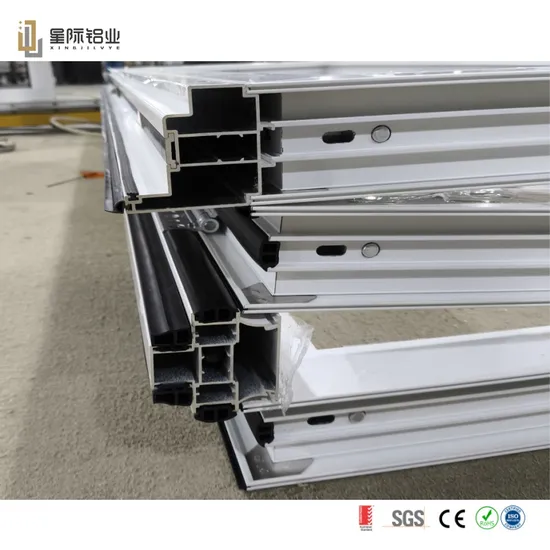
A raw aluminum frame is an excellent conductor of heat. In winter, it transfers interior warmth to the outside; in summer, it does the reverse. The solution is a “thermal break”—a polyamide strip inserted between the interior and exterior aluminum profiles to interrupt heat flow.
Our thermal break aluminum profiles reduce heat transfer significantly, improving the window’s overall U-value and reducing HVAC loads. We assemble these profiles in-house, which means we control the quality of the thermal break insertion and the powder coating finish. This ensures our windows meet international energy standards such as ENERGY STAR requirements for various climate zones [2].
Our Manufacturing Process: From Raw Aluminum to Finished Tempered Glass Unit
Transparency in manufacturing builds trust. Here is exactly how we produce a tempered glass aluminum window in our factory, from raw profile to finished, shippable unit.
Precision Cutting and Frame Assembly in Our Workshops
The process begins with aluminum profiles cut to exact lengths using CNC saws. Our operators then mill drainage slots, hardware mounting holes, and corner joints with precision machining centers. Each corner is crimped and sealed with structural adhesive to ensure water tightness and structural integrity.
Unlike trading companies that outsource fabrication, we operate our own aluminum processing workshops. This vertical integration means every batch is subject to our quality control protocols—from checking profile surface finish for scratches to verifying corner squareness with calibrated gauges. We do not rely on third-party inspection reports; our team walks the production floor daily.
Quality Control Checkpoints for Glass and Hardware
The tempered glass we use is sourced from certified glass processors who follow ASTM C1048 standards for flat glass tempering [3]. Upon delivery, our QC team inspects each pane for:
- Nickel sulfide inclusions (which can cause spontaneous breakage)
- Edge chips or cracks from handling
- Optical distortion from the tempering process
We also test the hardware—hinges, locks, and multi-point locking systems—to ensure smooth operation and durability. The hardware accessories we supply are matched to the weight and size of each window unit. A heavy tempered glass sash requires heavy-duty hinges; we specify accordingly to prevent sagging over time.
Customization Options for Global Projects: OEM & ODM Services
Stock windows rarely fit the unique dimensions and aesthetic requirements of custom architectural projects. Our OEM and ODM capabilities exist specifically to solve this problem for contractors, architects, and developers.
Custom Sizes, Shapes, and Color Finishes
We fabricate windows to your exact dimensions—not just standard metric sizes. Need a 2.4-meter-wide fixed pane for a commercial storefront? We can build it. Need a trapezoidal window for an architectural feature wall? Our engineering team can design the frame geometry and glass shape.
For finishes, we offer:
- Powder coating in a wide range of RAL colors, with UV-resistant formulations for exterior durability
- Anodizing for a metallic, corrosion-resistant surface
- Wood grain finishes that replicate timber aesthetics on aluminum profiles, matching interior design schemes
Our in-house spray finishing workshop controls coating thickness and curing temperatures, ensuring consistent color and adhesion across every batch.
Private Labeling and Bulk Supply for Developers
For retail dealers and villa real estate developers, brand consistency matters. Our private label service allows you to place your logo on the glass corner, frame, and packaging. This supports your brand identity while we handle the manufacturing complexity behind the scenes.
Our experienced in-house design and engineering team works directly from your architectural shop drawings. We provide customized shop drawings and formal quotations within 24 hours of receiving your inquiry. This rapid response accelerates your project timeline—you do not wait weeks for a supplier to interpret your drawings.
Project Logistics: MOQs, Lead Times, and Shipping Protection
Supply chain reliability is as important as product quality. A window that arrives late or damaged can halt an entire construction schedule. Here is how we manage project logistics.
Flexible Minimum Order Quantities (MOQs)
We understand that not every project is a 10,000-unit high-rise development. A boutique villa project may require only 50 units; a retail dealer may need a mixed container of different sizes. Our flexible MOQs accommodate both scenarios. We work with you to determine a production batch that meets your project scale without forcing you to over-order.
Fast Production Schedules and Secure Export Packaging
Our efficient workshop management allows for faster production lead times than many competitors. A typical bulk order of custom aluminum windows can be produced and ready for shipment in 4–6 weeks, depending on complexity and quantity. We schedule production based on your project’s installation timeline, not just our factory capacity.
For export, we use heavy-duty packaging designed for ocean freight. Each window is wrapped with protective film, corner-protected with cardboard or foam, and crated or palletized to prevent movement during transit. Our comprehensive after-sales support includes shipping damage protection—if a unit arrives damaged, we work with you to resolve the claim and replace the product promptly.
Common Questions from B2B Buyers
Can tempered glass aluminum windows be cut or drilled on-site?
No. Tempered glass cannot be cut, drilled, or modified after the tempering process—any attempt will cause it to shatter. We fabricate every pane to your exact specifications in our factory before shipping. This is why accurate measurements and shop drawings are essential before production begins.
What is the typical lead time for a bulk order of custom aluminum windows?
Lead times vary based on quantity and complexity, but our efficient production lines typically complete bulk orders in 4–6 weeks. For standard sizes with readily available profiles, we can be faster. Contact our team with your project details for a specific timeline.
Do you offer different color finishes for the aluminum frames?
Yes. We offer a wide range of powder coating colors and anodized finishes. Our in-house spray finishing workshop controls quality strictly, ensuring UV resistance and color longevity even in harsh sunlight exposure.
Are your windows suitable for hurricane or high-wind zones?
Yes. Our engineering team designs frames and specifies tempered glass thicknesses that meet international building codes for wind load and impact resistance, including ASTM E1886 and E1996 standards for hurricane-prone regions [4][5].
Can you put our logo on the windows and packaging?
Absolutely. As part of our OEM and Private Label services, we customize branding on the glass corner, frame, and packaging. This supports your brand identity in the local market while we handle manufacturing.
Choosing the Right Manufacturing Partner
Selecting a window manufacturer is as critical as selecting the window specification itself. A supplier with in-house processing capabilities, engineering support, and proven export experience reduces your project risk.
Choose Jusen Doors & Windows Manufacturing Co., Ltd. if you need:
- A direct factory source with over 20 years of aluminum processing experience
- OEM/ODM customization with private labeling support
- Engineering assistance with wind load calculations and glass specifications
- Flexible MOQs and reliable export logistics with damage protection
We invite global distributors, builders, architects, and project partners to collaborate with us. Send us your project drawings, and our team will provide a customized solution and formal quotation within 24 hours.
References
[1] Glass Association of North America. “Tempered Glass Properties and Testing.” https://www.glasswebsite.com/technical-info/tempered-glass
[2] U.S. Department of Energy. “Energy-Efficient Window Attachments.” https://www.energy.gov/energysaver/energy-efficient-window-attachments
[3] ASTM International. “ASTM C1048-18 Standard Specification for Heat-Strengthened and Fully Tempered Flat Glass.” https://www.astm.org/c1048-18.html
[4] ASTM International. “ASTM E1886-19 Standard Test Method for Performance of Exterior Windows, Curtain Walls, Doors, and Impact Protective Systems Impacted by Missile(s) and Exposed to Cyclic Pressure Differentials.” https://www.astm.org/e1886-19.html
[5] ASTM International. “ASTM E1996-20 Standard Specification for Performance of Exterior Windows, Curtain Walls, Doors, and Impact Protective Systems Impacted by Windborne Debris in Hurricanes.” https://www.astm.org/e1996-20.html