Content Menu
● 1. 1. What Is a Glass Outside Door? Definitions and Product Categories
● 2. 2. Types of Glass for Outside Doors: A Technical Breakdown
● 3. 3. Factors to Consider When Choosing Glass for Outside Doors
● 4. 4. How Much Does a Glass Front Door Cost? Pricing Breakdown for Buyers
● 5. 5. Maintenance and Care for Glass Outside Doors
● 6. 6. Sourcing Glass Outside Doors from a Factory: What B2B Buyers Must Know
● 7. 7. Why Choose a Direct Factory Partner for Glass Outside Doors
13 min read
A buyer once unloaded a container where the door frames and glazing were fine, but the drainage holes were positioned for a monsoon climate—and the shipment was headed to a desert market where sand would clog them within a season. That is the difference between buying a product and buying one engineered for your market.
A glass outside door is not a simple product. It is a structural component combining thermal performance, safety glazing, weather resistance, and security hardware—and getting any one of those wrong creates a field failure that costs far more than the door itself.
This guide covers what B2B buyers need to know: product categories, glass specifications, cost drivers, quality evaluation frameworks, and what to demand from a factory partner.
1. What Is a Glass Outside Door? Definitions and Product Categories
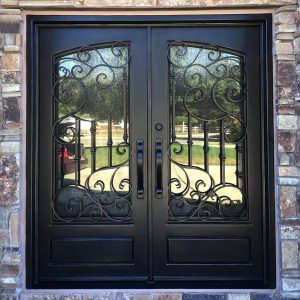
A glass outside door is an exterior entry point where glass serves as a primary structural or visual component. Unlike interior partition doors, these units must withstand wind loads, temperature differentials, moisture, and forced entry attempts—while maintaining a seal that keeps weather outside.
1.1 Common Product Types in the Glass Outside Door Category
The market splits into four main configurations:
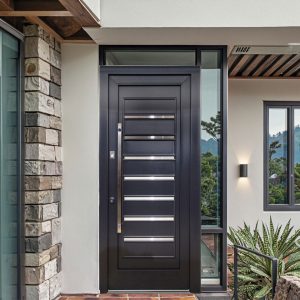
Aluminum glass entrance doors. These use aluminum frames—typically thermal-break profiles—with single or double glazing. They dominate commercial storefronts and high-end residential projects because aluminum offers structural rigidity, corrosion resistance, and unlimited powder-coating color options.
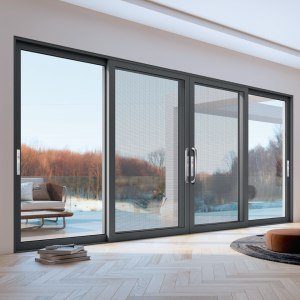
Sliding glass doors. Patio and balcony access points use multi-track systems where panels slide horizontally. These range from simple two-panel configurations to three- or four-track systems with multiple sliding panels.
Folding glass doors. Bi-fold or multi-fold systems stack panels to one side, opening wide openings entirely. These are popular in hospitality and luxury residential projects where indoor-outdoor flow matters.
Hybrid doors with glass inserts. Solid wood or aluminum-clad doors with glazed sections. These suit villa projects where the entrance needs a warmer aesthetic but still benefits from natural light.
The frame material choice matters. Aluminum dominates because of its strength-to-weight ratio and thermal-break capability. uPVC is cheaper but less rigid. Steel is strong but heavy and prone to corrosion without proper finishing. Wood requires ongoing maintenance but offers aesthetics metal cannot match.
1.2 Where Glass Outside Doors Are Used
- Residential: villa entrances, patio doors, garden access points
- Commercial: storefronts, office entrances, restaurant terraces
- Hospitality: hotel entrances, resort villas, beachfront properties
- Public buildings: hospitals, schools, municipal buildings
1.3 Key Terminology Buyers Should Know
- Thermal break: A polyamide or PVC barrier between interior and exterior aluminum profiles that reduces heat transfer
- Tempered glass: Heat-treated glass that shatters into small granules rather than sharp shards
- Laminated glass: Two or more glass layers bonded with a PVB or EVA interlayer that holds the glass together when broken
- Low-E coating: A microscopically thin metallic layer that reflects infrared radiation while transmitting visible light
- U-value: A measure of heat transfer rate—lower is better for insulation
- Air infiltration rating: The amount of air that passes through a closed door assembly under pressure
2. Types of Glass for Outside Doors: A Technical Breakdown
The glass specification is often the most critical decision in a glass outside door order. The frame holds everything together, but the glass determines safety, thermal performance, and acoustic insulation.
2.1 Tempered Glass vs. Laminated Glass
Tempered glass is heated to about 620°C and rapidly cooled, creating surface compression that makes it four to five times stronger than annealed glass. When it breaks, it shatters into small, relatively harmless granules. Most building codes require tempered glass in “hazardous locations”—which includes exterior doors.
Laminated glass consists of two or more panes bonded with a PVB interlayer. When broken, fragments adhere to the interlayer, maintaining the door’s integrity. This makes it the preferred choice for security applications and high wind-load requirements.
The honest caveat: laminated glass costs more than tempered. For budget-sensitive projects, tempered alone meets most code requirements. But if the door faces a hurricane zone or high-theft area, laminated glass is a requirement, not an option.
| Property | Tempered Glass | Laminated Glass |
|---|---|---|
| Strength | 4-5x annealed glass | Similar to annealed, but holds shape when broken |
| Break pattern | Small granules | Fragments adhere to interlayer |
| Security | Moderate | High (resists forced entry) |
| Sound insulation | Moderate | Better (interlayer dampens sound) |
| Cost | Lower | Higher (typically 30-50% more) |
| Code compliance | Meets safety glazing codes | Meets safety glazing + security requirements |
2.2 Insulated Glass Units (IGU) / Double Glazing
An IGU consists of two or more glass panes separated by a spacer and sealed to create an air gap, often filled with argon or krypton gas—both denser than air and better insulators. A standard IGU with a 12mm argon-filled gap achieves a U-value around 1.0-1.2 W/m²K, compared to roughly 5.8 W/m²K for single glazing.
For exterior doors in colder climates, IGUs are not optional. They prevent condensation on interior surfaces, reduce heating costs, and improve occupant comfort.
2.3 Low-E Coating and Solar Control Glass
Low-E coatings are microscopically thin metallic layers—typically silver, tin oxide, or zinc oxide—applied to glass surfaces. They reflect long-wave infrared radiation (heat) while allowing short-wave visible light to pass through. In winter, interior heat stays inside; in summer, exterior solar heat stays outside.
Solar control glass goes further, incorporating tinted or reflective coatings that reduce solar heat gain coefficient (SHGC). For hot climates, a low SHGC (0.25-0.40) is essential to prevent interior overheating.
2.4 Specialty Glass Options
- Frosted or translucent glass: Sandblasted or acid-etched for privacy while transmitting light
- Decorative glass: Patterns, ceramic frits, colored interlayers for aesthetic projects
- Fire-rated glass: Wired or ceramic glass that maintains integrity during a fire—required in some commercial applications
- Acoustic glass: Laminated glass with specialized interlayers that reduce sound transmission—important near highways or airports
3. Factors to Consider When Choosing Glass for Outside Doors
A procurement framework for B2B buyers should evaluate four dimensions before placing an order.
3.1 Climate and Energy Performance
U-value requirements vary by region. A project in northern Europe might require a U-value of 1.0 W/m²K or lower, while a project in Southeast Asia might prioritize SHGC over U-value. Buyers should obtain local energy code requirements and specify glass performance accordingly.
3.2 Safety and Building Code Compliance
Most building codes require safety glazing in exterior doors. The International Building Code (IBC), for example, requires tempered or laminated glass in hazardous locations—including doors and sidelites. Wind load resistance is a separate consideration: high-rise buildings and coastal areas require glass that withstands specific wind pressures.
3.3 Security Considerations
Laminated glass is the standard for security applications. Combined with multi-point locking systems—which engage at multiple points along the door edge—it creates a substantial barrier against forced entry. Frame reinforcement in hinge and lock areas further improves security.
3.4 Aesthetic and Design Compatibility
Frame finish (powder coating, anodizing), glass tint, and reflectivity all affect the building’s appearance. Custom shapes and sizes are possible, but they increase cost and lead time. Buyers should balance design intent against budget constraints.
4. How Much Does a Glass Front Door Cost? Pricing Breakdown for Buyers
There is no fixed price for a glass outside door. The range is enormous because the specification determines the cost.
4.1 Cost Drivers in a Glass Outside Door
- Frame material: Aluminum is mid-range; wood is more expensive; steel is comparable to aluminum but heavier
- Glass type: Single glazing is cheapest; double glazing adds roughly 30-50%; triple glazing adds another 30%
- Laminated vs. tempered: Laminated adds 30-50% over tempered
- Hardware quality: Multi-point locking systems, branded hinges, and premium handles add $50-200 per door
- Size and custom dimensions: Non-standard sizes require custom fabrication, increasing cost
- Finish: Custom powder-coating colors and anodized finishes add a small premium
4.2 Price Ranges by Category (Indicative for B2B Planning)
| Category | Price Range (Wholesale, per unit) |
|---|---|
| Aluminum glass entrance door | $300 – $1,200 |
| Sliding glass door system | $500 – $2,000 |
| Folding glass door system | $1,000 – $4,000 |
These ranges assume standard sizes and moderate glass specifications. Volume orders typically qualify for tiered discounts.
4.3 Why Factory-Direct Pricing Matters
Working through intermediaries adds 20-40% to the cost. Factory-direct purchasing eliminates that markup but requires the buyer to manage logistics, documentation, and quality oversight. For bulk orders, the savings justify the effort.
5. Maintenance and Care for Glass Outside Doors
Even well-made doors require maintenance. Buyers should plan for it—and specify products that make maintenance easier.
5.1 Routine Cleaning and Inspection
Aluminum frames clean well with mild soap and water. Abrasive cleaners damage powder-coated surfaces. Glass should be cleaned with a pH-neutral glass cleaner. Seals and gaskets need inspection every six months for wear or displacement.
5.2 Common Issues and Prevention
Condensation between glass panes indicates a failed seal in the IGU—a manufacturing defect covered by warranty, typically 5-10 years. Hardware misalignment occurs when hinges or locks loosen over time. Regular lubrication of moving parts—rollers, hinges, locks—prevents premature wear. Weatherstripping degrades after 3-5 years and should be replaced proactively.
5.3 Warranty and After-Sales Considerations
A typical factory warranty covers manufacturing defects in frames, glass, and hardware for 1-3 years. IGUs carry a separate warranty for seal failure. Buyers should confirm spare parts availability before ordering—a door that cannot be repaired becomes a liability.
6. Sourcing Glass Outside Doors from a Factory: What B2B Buyers Must Know
The supply chain for glass outside doors typically runs: manufacturer → importer/distributor → contractor/installer. Each intermediary adds cost and introduces quality-control gaps. Direct factory sourcing changes the economics—but only if the buyer knows what to demand.
6.1 How the Industry Works: From Factory to Project Site
A reputable factory produces doors to specification, performs pre-shipment inspection, and ships with complete export documentation. The buyer’s responsibility is to verify that the factory can actually deliver what it promises—consistently, at scale, and to the required standards.
6.2 What a Reliable Factory Should Provide
Customization capability. Size, color, glass type, and hardware accessories should all be configurable to project specifications. A factory that only produces standard sizes is not a true manufacturing partner.
Testing and compliance. Exterior doors must pass air-tightness, water-tightness, and wind resistance tests. A factory that performs these tests before shipment—and provides test reports—demonstrates quality control.
Export documentation. Packing lists, proforma invoices, and full customs documents are essential for smooth import clearance. Delays in documentation create delays in delivery.
Adjustable profiles and fittings. Building codes differ by market. A factory that can adjust profile structures and fittings to match local codes—European, North American, Middle Eastern, Southeast Asian—is far more valuable than one that offers a single standard product.
6.3 How We Meet These Standards
As a manufacturer, our approach to glass outside door production is built around direct supply and full customization. We produce thermal-break aluminum doors, system windows, sliding doors, and aluminum entrance doors with glass configurations tailored to your project requirements.
Every order undergoes strict pre-shipment inspection covering air-tightness, water-tightness, and wind resistance—the three tests that matter most for exterior doors. Our foreign trade experience means you receive complete export documentation, from packing lists to customs paperwork, with no back-and-forth delays.
We adjust profile structures and fittings to align with the building codes of your target market—whether that is European, North American, Middle Eastern, or Southeast Asian standards. Shipping is available via FCL or LCL directly from our China factory, with flexible logistics to match your project timeline.
6.4 OEM and ODM Partnership Models
OEM: We manufacture to your specifications, using your designs or drawings. You control the product design; we handle production.
ODM: We offer our own designs that you can brand as your own (private label). This reduces your design costs while still giving you a differentiated product.
Custom projects: For construction companies and developers, we support bulk supply with consistent quality across large orders. Consistency matters—every door in a project must match the approved sample.
7. Why Choose a Direct Factory Partner for Glass Outside Doors
7.1 Stable Supply and Consistent Quality
Factory-direct manufacturing means you are not dependent on intermediaries who may lack quality control. Batch-to-batch consistency matters in large projects—a factory with in-house production control delivers that.
7.2 Competitive Pricing Without Middleman Markup
When you buy direct, you eliminate the distributor’s margin. That directly improves your cost position in the market—and gives you room to compete on price or improve your own margins.
7.3 Long-Term Partnership for Repeat Projects
A factory partner who understands your market’s codes and preferences becomes a strategic asset for future projects. They know what works, what fails, and what your customers expect. That knowledge compounds over time.
—
Frequently Asked Questions
What is a glass door in front of a front door called?
A glass door installed in front of the main entrance door is commonly called a storm door or security glass door. In modern architecture, it may also be referred to as a glass entrance screen or outer glass door. These are typically aluminum-framed glass doors that protect the primary door while allowing natural light in.
How much does a glass front door cost?
For B2B buyers, the wholesale cost of a glass front door varies by specification. A standard aluminum glass entrance door with double glazing typically ranges from $300 to $1,200 per unit at factory-direct pricing. Custom sizes, laminated glass, premium hardware, and thermal-break frames increase the price. High-end folding glass door systems can range from $1,000 to $4,000 per unit. Volume orders generally qualify for tiered discounts.
What is a glass front door?
A glass front door is an exterior entry door that features glass as a primary component—either fully glazed or with a glass insert. The frame is typically made of aluminum, steel, or wood. Glass front doors are used in residential villas, commercial storefronts, and public buildings to provide natural light, visibility, and modern aesthetics while maintaining security and thermal performance.
Is it okay to have a glass front door?
Yes, when properly specified. The key is selecting the right glass type—tempered or laminated glass—and ensuring the frame provides adequate structural support. For exterior applications, insulated glass units (IGUs) with Low-E coating are recommended for energy efficiency. A reputable factory will test for air-tightness, water-tightness, and wind resistance to ensure the door performs reliably in real-world conditions.
What glass is best for an outside door?
The best glass depends on your priorities:
- For safety: Laminated glass (holds together when shattered)
- For energy efficiency: Double-glazed IGU with Low-E coating and argon gas fill
- For security: Laminated glass combined with a multi-point locking system
- For privacy: Frosted or tinted glass
In most cases, a combination of tempered and laminated glass in an insulated unit offers the best balance of safety, insulation, and security.
Can I customize the size and color of glass outside doors for my project?
Yes. Factories that support OEM and ODM orders offer full customization on dimensions, frame color (powder coating or anodized finishes), glass type, and hardware accessories. For large construction projects, profiles and fittings can be adjusted to match local building codes in your target market.
How do I evaluate a glass outside door supplier?
Evaluate on four dimensions: production capability (can they produce your specification at scale?), quality control (do they test before shipment?), export experience (can they handle documentation and logistics?), and reference projects (have they delivered similar products to your market?). A factory that cannot show test reports for air-tightness, water-tightness, and wind resistance is not a qualified supplier.
What is the minimum order quantity for glass outside doors?
MOQ varies by factory and product type. Standard aluminum glass entrance doors typically have an MOQ of 50-100 units. Custom sizes and specialty glass configurations may require higher minimums. Some factories offer sample orders at higher per-unit pricing for evaluation before committing to bulk quantities.
How long does shipping take from a China factory?
FCL (full container load) shipments typically take 20-35 days to reach North American or European ports, depending on the destination. LCL (less than container load) shipments may take longer due to consolidation. Factories with export experience coordinate with freight forwarders to ensure smooth customs clearance at both ends.
What is a thermal break in an aluminum door frame?
A thermal break is a polyamide or PVC strip inserted between the interior and exterior aluminum profiles of a door frame. It interrupts the thermal bridge that would otherwise conduct heat through the metal. Thermal-break frames are essential for energy-efficient exterior doors in cold climates.
—
Conclusion
A glass outside door is a structural investment, not a commodity purchase. The glass specification, frame material, hardware, and testing protocols all determine whether the door performs for years or fails within months. Buyers who understand these factors—and who demand test reports, customization capability, and export competence from their factory partners—position themselves for long-term success.
The procurement decision comes down to three questions: Does the factory produce to your specification? Do they test before shipping? Can they deliver the documentation and logistics support you need? If the answer to all three is yes, you have found a partner worth working with.
When you are ready to discuss your project specifications—glass type, frame dimensions, hardware requirements, or target market codes—reach out to our team. We will walk through the technical details and provide a quote based on your actual requirements.
—
References
- International Code Council. (2021). International Building Code (IBC). https://codes.iccsafe.org/
- National Fenestration Rating Council. (2023). Understanding U-Factors and SHGC. https://www.nfrc.org/
- Glass Association of North America. (2022). Glazing Manual. https://www.glasswebsite.com/
- American Architectural Manufacturers Association. (2023). AAMA/WDMA/CSA 101/I.S.2/A440-17. https://www.aamanet.org/
- European Committee for Standardization. (2020). EN 14351-1: Windows and doors. https://www.cencenelec.eu/