Content Menu
● 1. What Is a “Front Door Single” and Why Does It Matter as a Product Category?
● 2. Anatomy of a Single Front Door: Core Components Every Buyer Must Specify
● 3. Sidelights and Configurations: Expanding the “Single Door” Product Line
● 4. Front Door Features & Options: What End-Clients Demand
● 5. How to Source Single Front Doors: A Procurement Framework for B2B Buyers
● 6. Meeting the Standards: How Our Factory Aligns with the Procurement Framework Above
● 7. Our Product Range for Single Front Door Supply
● 8. Partnership Models: How We Work with B2B Buyers
● 9. Production Process: From Raw Material to Finished Door
● 10. Quality Control: Our Multi-Stage Inspection Process
● 11. Certifications and Industry Standards
16 min read
When a European distributor places a first container order for single front doors, the key concern is rarely price. It is whether the factory can replicate the sample’s thermal performance across 300 units—and whether the promised U-value will survive a third-party audit at the port of Rotterdam.
This guide is written for B2B buyers—importers, distributors, contractors, and hardware retailers—who need to source single front doors with confidence. It walks through the technical specifications that matter, the supplier evaluation framework that separates capable factories from trading companies, and the procurement pitfalls that cost buyers money.
What Is a “Front Door Single” and Why Does It Matter as a Product Category?
A “front door single” refers to a single-leaf entrance door—one active door panel within a single frame—as distinct from double doors, French doors, or sliding patio units. It is the most common entrance configuration in residential and light-commercial construction worldwide.
Single front doors dominate because they are cost-efficient per opening, require less wall space, and deliver better thermal performance than double doors (which have a larger glazing-to-frame ratio and a more complex weather seal). For a B2B buyer, treating “front door single” as a distinct SKU category matters because it has its own specification logic, testing parameters, and customer expectations.
A standard single front door unit includes the door leaf, the surrounding frame, hinges, locking hardware, and—in most modern configurations—sidelight panels or transom windows. Each component contributes to the door’s final performance rating.
Anatomy of a Single Front Door: Core Components Every Buyer Must Specify
Door Leaf Construction: Solid Wood vs. Aluminum vs. Composite
The substrate choice dictates price point, lead time, and target market fit. There is no universal “best” material—only the right material for your market’s climate, security expectations, and architectural style.
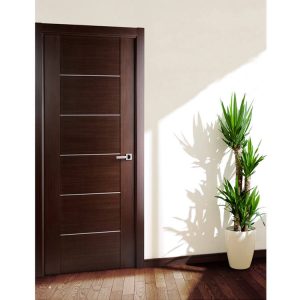
Solid wood doors remain the default for high-end residential projects. Oak, mahogany, and teak offer aesthetic gravity that no aluminum profile can replicate. For high-humidity coastal areas, buyers should prioritize moisture resistance; a solid wood door that warps within six months creates warranty claims that erase any margin gained.
Thermal-break aluminum doors have become the workhorse of modern architecture. The thermal break—a polyamide strip inserted between the interior and exterior aluminum profiles—interrupts the cold bridge and dramatically improves insulation. These doors offer structural rigidity, slim sightlines, and high recyclability, making them ideal for high-traffic commercial applications and contemporary residential builds.
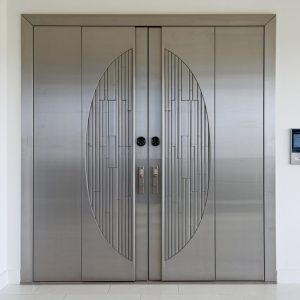
Composite and steel doors focus on security and minimal maintenance. They are common in North American markets where forced entry resistance is the primary purchase driver. The trade-off is design flexibility—steel offers limited customization compared to wood or aluminum.
| Material | Thermal Performance | Security | Maintenance | Design Flexibility | Typical Price Range |
|---|---|---|---|---|---|
| Solid Wood | Good (with proper core) | Good (with reinforced hardware) | High — needs refinishing | Excellent — carvings, stains | $$$ |
| Thermal-Break Aluminum | Excellent — U-value ≤ 1.3 W/m²K | Excellent — RC2/RC3 multi-point locks | Low — powder coating is durable | Good — slim profiles, custom colors | $$ |
| Composite/Steel | Moderate | Excellent — steel core | Low | Limited — factory-fixed designs | $–$$ |
Frame Systems and Thermal Performance
The frame is where thermal performance is won or lost. A multi-chamber frame profile—with multiple internal air cavities—performs significantly better than a single-chamber profile. Buyers should request the specific U-value (thermal transmittance) for the complete door assembly, not just the glazing. A U-value of ≤ 1.3 W/m²K is the baseline for cold climates; Passive House projects require ≤ 0.8 W/m²K.
Air-tightness and water-tightness ratings matter equally. Per EN 12207, air-tightness class 4 is the minimum for most European projects. Per EN 12208, water-tightness class 7A–9A is expected for exposed locations. These ratings are test results from accredited laboratories—request the test report.
Hardware, Glazing, and Security Integration
Security hardware is the single most important differentiator for front doors. Multi-point locking systems—which engage bolts at multiple points along the door edge—are standard for security grade RC2 (resistance to opportunistic burglary) and RC3 (resistance to determined burglary) per EN 1627. The lock cylinder, strike plate, and hinge reinforcement determine the actual security level—not just the lock brand.
Glazing options include double glazing (two panes with a gas-filled cavity), triple glazing (three panes for extreme climates), low-E coatings (which reflect heat back into the interior), and laminated safety glass (which holds together when shattered). Each option affects the U-value, sound insulation rating, and price.
Sidelights and Configurations: Expanding the “Single Door” Product Line
Front Entry Door Sidelights to Perfect Your Design
Sidelights are fixed glazed panels that flank one or both sides of a single door. They increase natural light in the entryway, enhance curb appeal, and—from a B2B perspective—justify a higher retail margin than a bare door unit.
Standard sidelight widths range from 12 to 18 inches. The panels integrate with the main door frame through a mullion—a vertical structural member that joins the door frame to the sidelight frame. The mullion must be thermally broken to avoid a cold bridge at the junction.
Sidelights by Material: Matching the Door Leaf
For a cohesive product line, sidelights should match the door leaf material. Aluminum sidelights use the same thermal-break profiles as the main door, ensuring consistent thermal performance. Wood sidelights require matching grain and stain to be visually seamless. Mixed-material sidelights—aluminum frame with wood interior cladding—offer the best of both but add manufacturing complexity.
Front Door Sidelight Inspiration: Configuration Patterns Buyers Should Stock
Three configurations dominate the market:
- Single door + one sidelight (left or right): Most common in suburban housing. The asymmetric look works well on lots where the door is offset from the property line.
- Single door + two sidelights: A symmetrical, high-end look. Often specified for larger entryways with generous ceiling heights.
- Door + sidelight + transom above: The transom window adds vertical drama and lets daylight penetrate deeper into the interior. This is a cross-sell opportunity—buyers who start with a single door can be upsold to a full entry system.
Front Door Features & Options: What End-Clients Demand
Security Features as a Selling Point
Security drives front door purchases. Data from the FBI’s Uniform Crime Reporting program indicates that roughly 34% of residential burglaries involve forced entry through the front door—a powerful conversation starter with end-clients.
The features that matter: multi-point locking, anti-pry hinges (which prevent the door from being lifted off its hinges), reinforced strike plates, and smart lock compatibility. Smart locks are no longer a retrofit afterthought—an increasing number of buyers expect factory-integrated smart lock options that hide the wiring within the door leaf.
Energy Efficiency and Insulation
Energy efficiency is the second purchase driver. The difference between a non-thermal aluminum door and a thermal-break version is significant—U-values can range from 5.0 W/m²K (non-thermal) down to 1.0 W/m²K (high-performance thermal-break with triple glazing). For a buyer sourcing for a market with strict energy codes, the thermal-break door is not optional.
Weatherstripping type matters. EPDM (ethylene propylene diene monomer) rubber offers excellent durability and compression set resistance. Silicone performs well in extreme temperatures. Brush seals are used for sliding applications but are less common on hinged doors.
Aesthetic Customization: Colors, Finishes, and Hardware
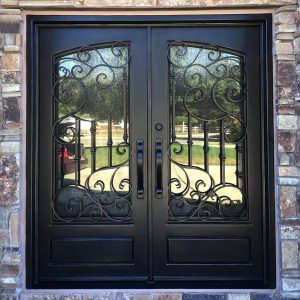
Powder-coating color ranges follow the RAL (European) or ANSI (American) color standards. Matte black and bronze finishes have dominated recent trends, but brass is making a comeback in traditional projects.
The lesson for B2B buyers: the more SKUs you can offer without holding inventory—via factory customization—the more projects you can quote. A factory that can produce 50 different RAL colors with a 15-day lead time is more valuable than one that offers 5 colors from stock.
How to Source Single Front Doors: A Procurement Framework for B2B Buyers
Evaluating a Factory: Beyond Price Per Unit
Price per unit is the last metric to compare, not the first. The evaluation should start with testing and certification. Does the factory have in-house testing equipment for air-tightness, water-tightness, and wind resistance? Or do they only provide test reports from third-party labs? Both are valid—but in-house testing suggests a culture of quality control, not just compliance.
Buyer checklist—questions to ask before ordering:
- Can you provide the EN 14351-1 or ASTM E330 test report for this specific door model?
- What is your pre-shipment inspection protocol? Who performs it, and can a third-party inspector visit your factory?
- Can you adjust the profile structure and fittings to match our local building codes? (e.g., ASTM E330 for wind load in North America, EN 14351-1 for Europe)
- What is your MOQ for a custom size and color? Does a pilot order count toward the MOQ?
- What is your defect rate on the previous 12 months of production? Can you provide a quality report?
Avoid suppliers who:
- Cannot produce a test report for the exact model they are quoting.
- Quote a price significantly lower than the market average without explaining the difference (material thickness? hardware brand? coating type?).
- Are unwilling to adjust their standard profiles to meet your market’s rough opening standards.
- Have no in-house inspection process and rely entirely on third-party QC.
MOQ, Lead Time, and Production Flexibility
Typical MOQs for single front doors range from 50 to 100 units per model and color combination. Factories that offer lower MOQs (10–20 units) usually charge a significant premium per unit to cover setup costs. For B2B buyers starting with a new product line, a pilot order of 20–30 units is a reasonable way to validate quality before committing to container volumes.
Lead times: 15–30 days for standard configurations, 30–45 days for custom sizes, colors, or hardware. The “adjustable profile structure” capability is critical—the factory should adapt to your market’s rough opening standards, not the reverse. A door that must be shimmed and filled to fit a non-standard opening will fail inspection.
Logistics and Documentation for Cross-Border Procurement
FCL (Full Container Load) shipping is cost-effective for large orders—a 40-foot container holds approximately 40–60 single front doors depending on size and packaging. LCL (Less than Container Load) is suitable for pilot orders but costs more per unit and carries a higher risk of damage from multiple handling points.
The documentation package matters as much as the product. A supplier with foreign trade experience should provide, as standard practice:
- Packing list (itemized by carton, with dimensions and weight)
- Proforma invoice (for customs valuation)
- Bill of lading (the contract of carriage)
- Certificate of origin (for tariff preference programs)
Choose A if… Choose B if…
Choose a thermal-break aluminum door if: Your market has strict energy codes, your projects are modern or commercial, and your end-clients expect a 10+ year lifespan with minimal maintenance.
Choose a solid wood door if: Your market is high-end residential, your clients prioritize aesthetics over energy performance, and you have a service network that can handle refinishing and moisture-related maintenance.
Choose a composite/steel door if: Your market prioritizes security above all else, the climate is extreme, and your clients are price-sensitive.
Meeting the Standards: How Our Factory Aligns with the Procurement Framework Above
The procurement framework above is not theoretical—it is the exact set of criteria we use to evaluate our own production lines.
As a manufacturer, our approach to pre-shipment inspection is straightforward: every batch of doors is tested for air-tightness, water-tightness, and wind resistance before it leaves our factory. We use the EN 12207 and EN 12208 classifications as our internal benchmarks, and we can provide the test data for each batch upon request.
Our profile structures and fittings are adjustable to match local building codes in your target market. Whether you need ASTM-compliant wind load ratings for a coastal project in Florida or EN-compliant thermal performance for a Scandinavian development, we adapt the product to your spec—not the reverse. This is not a premium service; it is standard practice.
On the logistics side, we handle both FCL and LCL shipments directly from our factory in China. Our foreign trade team prepares packing lists, proforma invoices, and full customs documentation as part of the standard order process. For buyers new to importing from China, we walk through the documentation requirements step by step.
Our Product Range for Single Front Door Supply
Our product range covers the three main categories buyers need:
Solid wood doors — oak, mahogany, and teak options for high-end residential projects. We offer custom sizes, custom carvings, and a range of stain finishes. Each door is kiln-dried to reduce moisture content to 8–12% before fabrication, which minimizes warping risk.
Thermal-break aluminum doors — slim-profile systems with double or triple glazing, multi-point locking, and RAL powder coating in any color. These are our most specified products for modern residential and commercial builds.
Aluminum alloy entrance doors — cost-effective, durable, and available in a wide color range. These are the entry-level option for projects where budget constraints dominate.
Our customization services include:
- OEM: You specify the design and performance requirements; we engineer and manufacture to your exact spec.
- ODM: We design the product based on your brief, including profile design, hardware selection, and glazing configuration.
- Private Label: Your brand on the product, packaging, and documentation.
Partnership Models: How We Work with B2B Buyers
We work with three main partnership models:
OEM/ODM partnerships — for buyers who have a specific design or performance requirement and need a factory that can deliver it consistently. We recommend starting with a pilot order of 10–20 units to validate fit, finish, and performance before committing to container volumes.
Private label partnerships — for buyers who want to sell under their own brand. We handle the manufacturing, packaging, and documentation under your brand name.
Bulk construction supply — for developers and contractors who need consistent quality across multiple buildings. We offer staged deliveries to match construction schedules, which reduces onsite storage requirements.
The ordering process is straightforward: send us your specifications (or your rough opening dimensions and performance requirements), and we will provide a quotation with a production timeline. Once you approve the sample—we can ship samples via express courier—we begin production and provide regular progress updates until the goods are ready for inspection and shipment.
Production Process: From Raw Material to Finished Door
Understanding the production process helps buyers evaluate quality claims. Here is the standard sequence for a thermal-break aluminum door:
- Extrusion: Aluminum billets are heated and forced through a die to create the profile shape. The die determines the cross-section—which is why custom profiles require a die investment (typically $2,000–$5,000 per profile).
- Thermal break insertion: Polyamide strips are inserted into the profile’s grooves and crimped into place. This is the critical step that creates the thermal break.
- Cutting and machining: Profiles are cut to length, and holes are drilled for hinges, locks, and drainage.
- Surface treatment: Profiles are either anodized or powder-coated. Powder coating involves electrostatic application of dry paint, followed by curing in an oven at 200°C.
- Assembly: Profiles are assembled into frames and door leaves. Hardware—hinges, locks, weatherstripping—is installed.
- Glazing: Glass units are inserted and secured with glazing beads and sealant.
- Quality control: Each door is checked for dimensions, squareness, hardware function, and surface finish.
For solid wood doors, the process differs: rough lumber is kiln-dried, then machined into stiles and rails, assembled with panels, sanded, and finished with multiple coats of lacquer or oil. The drying process is critical—wood with high moisture content will warp and crack as it acclimates to the destination climate.
Quality Control: Our Multi-Stage Inspection Process
Our quality control follows a three-stage process aligned with the framework described earlier:
Stage 1 — Incoming material inspection: Aluminum profiles are checked for alloy composition and surface finish. Glass units are checked for dimensions and edge quality. Hardware is verified against the order specification.
Stage 2 — In-process inspection: During assembly, technicians check critical dimensions at each step. The thermal break is tested for continuity. The door leaf is checked for squareness (diagonal tolerance within 2mm). Hardware function is tested on every unit.
Stage 3 — Pre-shipment inspection: Before packing, each door is tested for air-tightness, water-tightness, and wind resistance. These tests are performed on a sample basis from each production batch—typically 5% of the order, or a minimum of 2 units. The test results are documented and available for the buyer’s review.
Buyers are welcome to arrange third-party inspection before shipment. We will provide full access to the production floor and the relevant test equipment.
Certifications and Industry Standards
The certifications that matter for front doors are:
- EN 14351-1: The European product standard for windows and doors. It covers air permeability, water tightness, wind load resistance, thermal transmittance, and acoustic performance.
- EN 1627: The European standard for burglar resistance. Ratings range from RC1 (basic) to RC6 (high security).
- ASTM E330: The American standard for structural performance of exterior windows and doors under wind load.
- ISO 9001: The quality management system standard. A factory with ISO 9001 certification has documented procedures for quality control.
When evaluating a supplier, ask which standards they test against, and request the actual test reports. A supplier who cannot produce test reports for the specific door model they are quoting is guessing at their product’s performance—a risk not worth taking for an entrance door.
FAQ — Single Front Door Sourcing Questions
What is the typical MOQ for custom single front doors?
Most factories set the MOQ at 50–100 units per model and color combination. Some accept pilot orders of 10–20 units at a higher per-unit price. The MOQ exists because of setup costs—powder coating requires a specific color change, and profile cutting requires machine calibration. For buyers new to a product line, a pilot order is a sensible way to validate quality before committing to container volumes.
How do I verify that a front door meets local building codes?
Request the test report for the specific door model you are purchasing. The report should show air-tightness class, water-tightness class, and wind load resistance—tested per the relevant standard (EN 14351-1 in Europe, ASTM E330 in North America). If the factory cannot produce a report for the exact model, the door does not meet the code.
What is the difference between FCL and LCL shipping for doors?
FCL (Full Container Load) means you rent an entire container. It is cost-effective for large orders—a 40-foot container holds roughly 40–60 doors depending on size. LCL (Less than Container Load) means your goods share a container with other shippers. The per-unit cost is higher, and there is a greater risk of damage from multiple handling points. LCL is appropriate for pilot orders under 20 units.
Can I get a custom size for a single front door?
Yes. Factories adjust the profile cutting lengths and frame assembly to accommodate non-standard rough openings. The key is to provide the exact rough opening dimensions, not the door leaf dimensions. The factory will calculate the required frame and leaf sizes based on the installation gap and mounting type (new construction vs. retrofit).
How long does a typical production run take?
Standard configurations take 15–30 days from order confirmation to ready-for-shipment. Custom sizes, colors, or hardware add 10–15 days. After production, allow 2–5 days for pre-shipment inspection and packing, then 20–40 days for sea freight depending on the destination.
What documentation should a supplier provide for customs clearance?
The standard package includes a packing list (itemized by carton with dimensions and weight), a proforma invoice (for customs valuation), a bill of lading (the contract of carriage), and a certificate of origin (for tariff preference programs). A supplier with foreign trade experience should provide all of these without being asked.
Can the factory match a specific color or hardware finish?
Yes. Powder coating can match any RAL or ANSI color. Hardware finishes include matte black, brushed nickel, brass, and bronze. For hardware, it is important to specify the brand and model you want—most factories work with a range of hardware brands and can accommodate your preferred supplier.
—
When sourcing single front doors for your next project, the evaluation framework is clear: verify the test reports, confirm the customization capability, and check the documentation process. Those three factors determine whether your container arrives with doors that pass inspection—or with doors that create warranty claims.
As a factory that supplies single front doors directly to importers, distributors, and contractors worldwide, we build our production process around those exact criteria. Every batch is tested for air-tightness, water-tightness, and wind resistance before shipment. Every order includes full customs documentation. And every profile structure is adjustable to match your local building codes.
If you are evaluating factories for a single front door supply contract, we welcome the opportunity to walk you through our testing data, our customization capabilities, and our production timeline.
References
- EN 14351-1:2006+A2:2010, “Windows and doors — Product standard, performance characteristics,” European Committee for Standardization. https://www.cen.eu/
- EN 1627:2021, “Pedestrian doorsets, windows, curtain walling, grilles and blinds — Burglar resistance,” European Committee for Standardization. https://www.cen.eu/
- EN 12207:2016, “Windows and doors — Air permeability — Classification,” European Committee for Standardization. https://www.cen.eu/
- EN 12208:2000, “Windows and doors — Watertightness — Classification,” European Committee for Standardization. https://www.cen.eu/
- ASTM E330/E330M-14, “Standard Test Method for Structural Performance of Exterior Windows, Doors, Skylights and Curtain Walls by Uniform Static Air Pressure Difference,” ASTM International. https://www.astm.org/
- U.S. Department of Justice, Federal Bureau of Investigation, “Crime Data Explorer — Burglary Statistics.” https://crime-data-explorer.fr.cloud.gov/
- ISO 9001:2015, “Quality management systems — Requirements,” International Organization for Standardization. https://www.iso.org/