Content Menu
● 1. Understanding French Doors Exterior Wood: Types and Applications
● 2. What Are the Key Materials and Performance Factors?
● 3. What Sizes Do Exterior French Doors Come In?
● 4. Glazing and Energy Efficiency: What to Specify
● 5. How Much Should Exterior French Doors Cost?
● 6. How to Evaluate a Factory Supplier
● 7. Our Manufacturing Approach to Exterior Wood French Doors
● 8. Production Process: From Raw Material to Finished Door
● 9. Quality Control: Our Multi-Stage Inspection Process
● 10. Customization and OEM/ODM Options
● 11. Ordering Process: MOQ, Lead Time, and Shipping
13 min read
When a contractor sends a request for quotation for a 6’0″ x 6’8″ prehung double door unit, they are asking whether the unit will survive freeze-thaw cycles, shed water at the sill, and arrive without a cracked lite. The conversation is about the consequences of getting the specification wrong.
This guide covers what a buyer needs to know before placing that order: material science, sizing logic, glazing requirements, performance testing, and how factory-direct procurement changes the cost structure. It is written for procurement professionals.
Understanding French Doors Exterior Wood: Types and Applications
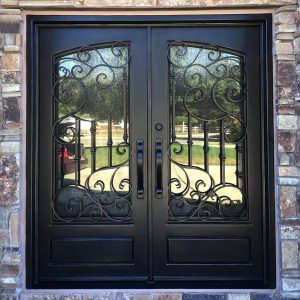
A French door is a hinged door with glass panels running most of its full length. The key distinction for exterior use is that the unit must manage weather — wind, rain, temperature differential, and UV exposure. French doors exterior wood are specified when the architect wants material continuity with interior millwork or a specific stain-grade aesthetic that aluminum and vinyl cannot replicate.
The Architectural Role in Residential and Light-Commercial Projects
Wood French doors appear in three primary contexts:
- Custom villas and high-end townhouses — where the entrance or patio opening is a design focal point.
- Hospitality projects — boutique hotels and resorts use them for balcony access in guest rooms.
- Light-commercial offices — ground-floor meeting rooms opening to courtyards or terraces.
In each case, the buyer is choosing between construction approaches — and the construction approach determines the performance ceiling.
Exterior vs. Interior Construction: A Critical Distinction
Interior French doors are simple: a slab, some hinges, a latch. Exterior units add layers of engineering:
| Component | Interior Door | Exterior Door |
|---|---|---|
| Glazing | Single-pane optional | Tempered or laminated, double-pane standard |
| Weatherstripping | None or minimal | Full perimeter, compression seals |
| Sill | None (floor-mounted) | Sill pan with drainage and slope |
| Core material | Any stable wood | Rot-resistant species or engineered core |
| Hardware | Standard latch | Multi-point locking, corrosion-resistant |
A buyer who specifies interior-grade units for exterior openings will face callbacks within 12 months. The wood will cup, the glass will fog, and the sill will leak. The industry standard for exterior procurement is the prehung double door unit — factory-assembled with frame, sill, and hardware, tested before shipment.
What Are the Key Materials and Performance Factors?
The material selection determines the door’s lifespan, maintenance interval, and price point. There is no single “best” species — there is only the best match for the project’s climate and finish requirements.
Wood Species Comparison
| Species | Rot Resistance | Dimensional Stability | Finish Compatibility | Relative Cost |
|---|---|---|---|---|
| Mahogany | High | Good | Stain-grade, natural | $$$$ |
| White Oak | High | Excellent | Stain or paint | $$$ |
| Primed Pine | Low-Medium | Fair | Paint only | $ |
| Engineered Composite | High | Excellent | Paint or stain | $$$ |
Mahogany and white oak are the standard choices for stain-grade exterior work. Primed pine is the economical option — it works when the budget requires it, but the buyer must accept a paint-only finish and a shorter lifespan in wet climates.
The less obvious point: the core construction matters more than the face species. An engineered core with laminated veneer lumber (LVL) offers better dimensional stability than solid wood for wide stiles. A 6’0″ wide double door has stiles that carry significant load; solid wood can warp over time. Engineered cores hold their shape.
Performance Standards That Matter
An exterior door unit must pass three tests to be considered fit for purpose:
- Air-tightness — measured in cubic meters per hour per square meter at a specified pressure differential. Lower is better.
- Water-tightness — tested by spraying water at increasing pressure levels. The unit must show no water penetration into the interior.
- Wind-load resistance — the frame and glass must withstand specified pressure without permanent deformation.
These tests predict real-world behavior: whether rain will weep through the bottom joint, whether the door will whistle in high winds, whether the glass will crack under pressure differentials.
What Sizes Do Exterior French Doors Come In?
Standard widths range from 5’0″ to 8’0″ in 2-inch increments. Heights are typically 6’8″ or 8’0″. The 8’0″ height has grown in popularity with the trend toward taller interior ceilings.
Common Lite Patterns
The “lite” count refers to the number of glass panels in the door:
- Full-lite — one continuous glass panel. Maximizes views and light.
- 6-lite — two columns, three rows. A traditional, balanced look.
- 10-lite — two columns, five rows. Elongated proportions that suit taller doors.
- 15-lite — three columns, five rows. The most traditional, divided appearance.
Grilles can be installed between glass panes (for easy cleaning) or surface-applied. Between-glass grilles are the better specification for exterior doors — surface-applied grilles collect moisture and become a maintenance issue.
Custom Sizing Is the Rule, Not the Exception
In high-end residential and commercial work, custom sizes are standard. The buyer provides:
- Rough opening width and height
- Jamb depth (wall thickness)
- Sill height requirement
- Swing direction
A factory with adjustable profile structures can accommodate these variations. This is the baseline expectation for a serious supplier.
In-Swing vs. Out-Swing
North American residential construction favors in-swing doors. Hurricane-prone regions often require out-swing — wind pressure pushes the door against its frame rather than pulling it away. Out-swing units need different weatherstripping and sill design because the door leaf sits outside the frame. Buyers must confirm the swing direction before ordering; it cannot be changed in the field.
Glazing and Energy Efficiency: What to Specify
The glass specification often costs more than the wood. Getting it right requires matching the glazing to the climate and the local building code.
Low-E Glass and Insulated Glass Units
Low-E (low-emissivity) coatings reflect infrared energy while admitting visible light. This means winter heat stays inside and summer heat stays outside. Double-pane construction with a low-E coating is the minimum standard for exterior French doors in most climates.
The specification “clear low-E” — frequently seen in prehung door units — refers to a coating that is nearly invisible while still providing thermal benefit. For buyers in cold climates, a lower U-factor (heat transfer rate) matters more than visible light transmission.
Climate and Code Considerations
- Coastal projects — impact-rated glass is often required by code. This means laminated glass with a plastic interlayer that holds shards together on impact.
- Cold climates — triple-pane glass reduces heat loss but adds weight. The hinges and frame must be specified to carry the additional load.
- High-altitude locations — glass thickness and airspace must account for pressure differentials.
A supplier that can adjust profile structures and fittings to match local building codes is a practical advantage — the alternative is a door that technically fits but fails inspection.
How Much Should Exterior French Doors Cost?
Pricing for exterior wood French doors follows a clear logic: material, glazing, and hardware.
Price Ranges by Configuration
| Configuration | Typical Price Range (Unit) |
|---|---|
| Primed pine, double-pane clear glass | $800 – $1,500 |
| White oak, double-pane low-E | $1,800 – $3,000 |
| Mahogany, triple-pane low-E | $2,500 – $4,500 |
| Fiberglass-clad wood, impact-rated | $3,000 – $5,500 |
These are project-priced items. A quote requires specifications — width, height, wood species, glass type, lite pattern, hardware grade, and quantity. No reputable manufacturer provides a list price without these details.
Why Factory-Direct Pricing Differs
The conventional supply chain for doors looks like this:
Manufacturer → Distributor → Dealer → Contractor → End Client
Each layer adds margin — typically 15–25% per step. Factory-direct procurement removes the distributor and dealer layers. For a B2B buyer, this means either higher margin on resale or more competitive end-client pricing. The structural advantage is the absence of intermediate markups.
Hidden Costs That Erase Price Advantages
- Incomplete pre-shipment inspection — a door that fails air-tightness testing in the field costs more in rework than the entire purchase price.
- Poor packing — transit damage to glass or frame corners turns a bargain into a loss.
- Incorrect sizing — a factory without engineering support produces doors that do not fit the opening.
- Documentation errors — missing customs paperwork delays shipments and incurs storage fees.
Factory-direct only works when the supplier has the process controls to prevent these failures.
How to Evaluate a Factory Supplier
The evaluation process has four pillars: testing protocol, customization capability, documentation readiness, and communication responsiveness.
Quality Assurance and Pre-Shipment Inspection
A rigorous inspection protocol includes:
- Air-tightness testing per international standards
- Water-tightness testing under simulated rain conditions
- Wind-load resistance verification
- Visual inspection for finish defects
- Hardware function checks
Buyers should request test reports and inspection documentation before shipment. A supplier that cannot produce these documents is a risk.
Questions to Ask Before Ordering
- What is your standard lead time for custom sizes?
- Can you adjust the profile structure to meet our local building code?
- What pre-shipment tests do you perform on every unit?
- Can you provide packing list, proforma invoice, and full customs documents?
- What is your MOQ for OEM production?
- Do you support private label branding?
- What is your process for handling transit damage claims?
Red Flags to Avoid
- Vague test claims — “We test everything” without naming the specific test standards.
- No documentation capability — a factory that cannot produce proper export paperwork will cause customs delays.
- Unwillingness to customize — standard sizes only signals a production line, not a manufacturing partner.
- No engineering support — if the factory cannot advise on jamb depth or sill slope, your project is the test case.
Decision Guide: Choose A If… Choose B If…
- Choose a local distributor if your project timeline is under 4 weeks and the order quantity is one or two units.
- Choose factory-direct if your project has a 6–10 week lead time, involves multiple units, or requires custom sizing.
- Choose a hybrid approach if you need one custom unit for a flagship project but lack the volume for a container order.
Our Manufacturing Approach to Exterior Wood French Doors
The standards described above are not theoretical for us. We build to them daily.
As a manufacturer, our approach to exterior wood French doors starts with the profile structure. We adjust it to match the local building codes of the target market — whether that means a deeper jamb for a thicker wall in a Canadian winter or a reinforced sill for a hurricane zone in Florida.
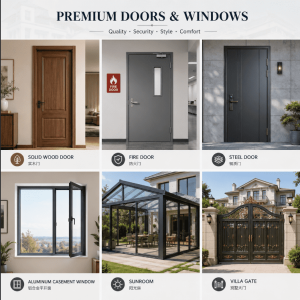
Our product range covers solid wood doors, thermal-break aluminum doors and windows, system windows, casement doors, sliding doors, and custom villa doors and windows. Exterior French doors are a core category, not a side line.
How We Support B2B Buyers Across the Procurement Cycle
- Full customization on size, color, glass, and hardware accessories — from lite patterns to multi-point locking systems.
- OEM, ODM, and private label support for distributors, contractors, and developers who need consistent, brandable supply.
- Adjustable profile structures and fittings to match local building codes — we adapt to your market, not the reverse.
Every unit undergoes strict pre-shipment inspection: air-tightness, water-tightness, and wind resistance tests. This is the standard for every unit that leaves our factory.
Factory-Direct Commercial Advantages
Direct supply from our factory means no middleman markup. The pricing advantage we pass to buyers is structural — it comes from removing distribution layers, not from promotional discounting.
With foreign trade experience, we provide the packing list, proforma invoice, and full customs documents your logistics team needs. Our shipping team manages both FCL and LCL deliveries, direct from our China factory to your port.
The one honest caveat: factory-direct procurement requires a 6–10 week lead time, a willingness to work with specifications rather than showroom inventory, and a volume that justifies the container. For buyers who meet those criteria, the cost advantage is significant.
Production Process: From Raw Material to Finished Door
Understanding how a door is built helps a buyer identify quality issues before they become field failures.
- Lumber selection and conditioning — wood is sourced and dried to a specific moisture content (typically 8–12%) to prevent post-installation movement.
- Core assembly — engineered cores are built from laminated veneer lumber for dimensional stability.
- Stile and rail machining — profiles are cut for glazing, weatherstripping, and hardware.
- Glass installation — insulated glass units are set with proper shimming and sealant.
- Sanding and finishing — surfaces are prepared for stain or paint.
- Hardware installation — hinges, locks, and weatherstripping are fitted.
- Pre-shipment testing — each unit is tested for air-tightness, water-tightness, and wind resistance.
- Packing — units are wrapped, crated, and loaded for FCL or LCL shipment.
The buyer cannot inspect these steps directly when ordering from overseas. What they can do is verify that the supplier has documented quality control at each stage.
Quality Control: Our Multi-Stage Inspection Process
Our quality control protocol is designed to catch defects before shipment, not after installation. The three core tests — air-tightness, water-tightness, and wind resistance — are performed on every exterior door unit.
| Test | What It Measures | Why It Matters |
|---|---|---|
| Air-tightness | Air leakage rate at pressure differential | Predicts drafts and energy loss |
| Water-tightness | Water penetration under simulated rain | Predicts leak performance in storms |
| Wind resistance | Frame and glass deformation under pressure | Predicts structural integrity in high winds |
Buyers can request inspection documentation for every unit or for a sampling protocol. We provide both options.
Customization and OEM/ODM Options
OEM (Original Equipment Manufacturing): The buyer provides the design or specification; we manufacture to those exact requirements. This is the right choice when the buyer has an established product line and needs manufacturing capacity.
ODM (Original Design Manufacturing): We provide design options from our existing range; the buyer selects and customizes. This is the right choice for buyers entering the market who need proven designs with their branding.
Private Label: We manufacture under the buyer’s brand name. This requires a minimum order quantity to justify the branding setup.
The practical question for buyers is not which model is “better” — it is which model matches the buyer’s market position and risk tolerance.
Ordering Process: MOQ, Lead Time, and Shipping
The ordering process follows a standard sequence:
- Specification submission — buyer provides dimensions, wood species, glass type, lite pattern, hardware, and quantity.
- Quote and sample — we provide pricing and, for larger orders, production samples.
- Order confirmation — buyer confirms specifications and we issue the proforma invoice.
- Production — typical lead time is 6–10 weeks depending on quantity and customization level.
- Pre-shipment inspection — buyer can request third-party inspection or rely on our test documentation.
- Shipping — FCL for full container loads, LCL for smaller quantities.
- Customs documentation — packing list, proforma invoice, and full customs documents provided.
Certifications and Industry Standards
The applicable standards vary by target market. Buyers should verify that the factory can meet the standards of their destination country. Key standards include:
- ASTM E283 — air leakage testing
- ASTM E547 — water penetration testing
- ASTM E330 — structural performance testing
We adjust our profile structures and fittings to meet the specific standards of the buyer’s target market. Confirm which standards apply to your project before placing an order.
—
What is the best brand for exterior French doors?
For B2B buyers, “best” depends on the project specification — wood species, performance testing, customization capability, and price point. The more relevant question is whether the manufacturer can meet your local building code requirements and delivery timeline. Factory-direct manufacturers with export experience can provide test documentation and adjust profiles to match your market’s standards.
What sizes do exterior French doors come in?
Standard widths range from 5’0″ to 8’0″, with heights typically at 6’8″ or 8’0″. Common configurations include 6-lite, 10-lite, and 15-lite patterns, plus full-lite units. For non-standard openings, most factories offer custom sizing — you provide the rough opening dimensions and jamb depth, and the door is built to fit.
Are French doors good for exterior use?
Yes, when specified correctly. Exterior French doors are built with weatherstripping, sill pans, tempered or laminated glazing, and rot-resistant wood species or engineered cores. The key is verifying that the manufacturer tests for air-tightness, water-tightness, and wind resistance — these are the performance criteria that separate exterior-rated units from interior-only doors.
How much should exterior French doors cost?
Pricing depends on material (primed pine vs. hardwood vs. fiberglass-clad), glazing (double vs. triple pane, low-E, impact-rated), lite pattern, and hardware. For B2B buyers, factory-direct pricing removes distribution markups, which can reduce cost by a significant margin. A quote requires your specifications — width, height, wood species, glass type, and quantity.
Can I order custom-sized exterior wood French doors for a construction project?
Yes. Custom sizing is standard in the industry for exterior French doors. A factory with OEM/ODM capability can manufacture to your rough opening dimensions, adjust profile structures and fittings to match local building codes, and provide private label branding if needed. Provide your project specifications and quantity to receive a production quote.
—
The procurement criteria are clear: wood species matched to climate, glazing matched to code, performance testing verified by documentation, and a supplier that can adapt to your market’s requirements. Factory-direct supply changes the cost equation for B2B buyers who can plan for the lead time.
If your project requires exterior wood French doors with confirmed performance testing and contact our team with your specifications.
References
- ASTM International. “ASTM E283 – Standard Test Method for Determining Rate of Air Leakage Through Exterior Windows, Skylights, Curtain Walls, and Doors Under Specified Pressure Differences Across the Specimen.” https://www.astm.org/e0283-19.html
- ASTM International. “ASTM E547 – Standard Test Method for Water Penetration of Exterior Windows, Skylights, Doors, and Curtain Walls by Cyclic Static Air Pressure Difference.” https://www.astm.org/e0547-00r16.html
- ASTM International. “ASTM E330 – Standard Test Method for Structural Performance of Exterior Windows, Skylights, Doors and Curtain Walls by Uniform Static Air Pressure Difference.” https://www.astm.org/e0330-14.html
- Efficient Windows Collaborative. “Low-E Coatings.” https://www.efficientwindows.org/goptions.php
- American Wood Council. “Design of Wood Framing.” https://awc.org/codes-standards/publications/