Content Menu
● 1. 1. Understanding Exterior Prehung Doors: Types and Applications
● 2. 2. Exterior Prehung Doors: Quality and Performance Factors
● 3. 3. How to Evaluate Exterior Prehung Doors Suppliers
● 4. 4. Key Quality Indicators for Exterior Prehung Doors Buyers
● 5. 5. Relevant Industry Standards and Certifications
● 6. 6. Production Process: From Raw Material to Finished Door
● 7. 7. Customization and OEM/ODM Options
● 8. 8. Ordering Process: MOQ, Lead Time, and Shipping
● 9. 9. Certifications and Industry Standards
● 10. 10. Jusen Door and Windows: Meeting the Standards Outlined in This Guide
● 11. 11. Case Studies: How Buyers Source Exterior Prehung Doors
11 min read
A distributor in Ohio once told me the real cost of a prehung door isn’t the invoice price. It’s the installation callbacks, the mismatched jambs, and the three-week delay waiting for replacement hardware. That conversation shapes how I advise buyers today: the door unit is the product, but consistency is the deliverable.
An exterior prehung door unit—the slab, frame, hinges, and weather-stripping assembled at the factory—removes the variables that plague on-site installation. For contractors, distributors, and importers buying in volume, the sourcing decision comes down to four factors: supply chain reliability, material consistency, customization depth, and the factory’s ability to document quality. This guide walks through those factors with the technical detail procurement teams need before placing a bulk order.
1. Understanding Exterior Prehung Doors: Types and Applications
An exterior prehung door is a complete door unit—slab, jambs, hinges, and sill pre-assembled at the factory—ready for installation into a rough opening. Buyers choose prehung units to reduce on-site labor, minimize installation errors, and ensure consistent hardware alignment across multiple units.
The commercial distinction matters. A slab door is just the panel; a prehung unit includes the frame system that transfers structural loads and seals against weather. For exterior applications, this means the unit must handle thermal expansion, moisture intrusion, and wind pressure as a single integrated system.
1.1 Solid Wood Prehung Units
Solid wood remains the specified choice for residential and architectural projects where appearance drives the specification. Common species include:
- Knotty alder — rustic grain, soft texture, accepts stain unevenly (which is the aesthetic point). Popular for craftsman and farmhouse styles.
- Red mahogany — dense, straight grain, takes a deep uniform finish. Common in 9-lite configurations with matching jambs.
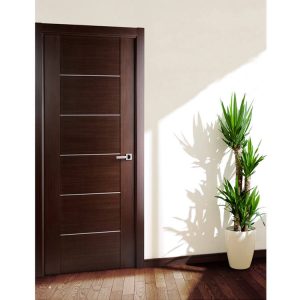
- Espresso mahogany — darker stain profile, often specified in modern 4-lite designs.
Wood units require factory-matched jambs. If the jamb material differs from the slab species, the stain acceptance changes, and the finished unit looks mismatched. Buyers should specify matching jambs on the purchase order, not assume it.
1.2 Fiberglass Prehung Units
Fiberglass has displaced wood in many entry-door applications because it solves two problems: dimensional stability and maintenance. A fiberglass slab doesn’t warp or swell with humidity changes, which means the factory can hold tighter tolerances on the prehung assembly.
Common configurations include beveled 4-lite fiberglass units with sidelites and 6-lite low-E glass units with transoms. The low-E coating on the glass reduces U-factor, which matters for energy code compliance in colder climates.
1.3 Aluminum Alloy and Thermal-Break Units
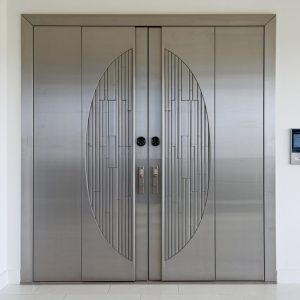
For commercial projects and high-end residential work, aluminum alloy entrance doors with thermal-break profiles are the specification of choice. The thermal break—a polyamide strip separating the interior and exterior aluminum sections—reduces heat transfer through the frame.
These units handle larger glass areas and slim sightlines that wood and fiberglass cannot achieve structurally. The trade-off: aluminum units cost more and require different hardware integration than wood or fiberglass. Casement-style entries, sliding units, and custom villa doors all fall into this category.
2. Exterior Prehung Doors: Quality and Performance Factors
Door quality is not a single attribute but a set of measurable performance characteristics: dimensional tolerance, air infiltration rate, water penetration resistance, and structural wind-load capacity. Each is testable under recognized standards.
2.1 Dimensional Tolerances
The frame must be square. A unit that racks even 3–4 mm during assembly will bind at the hinges or leave a visible gap at the strike plate. Factories should hold door slab width and height tolerances to ±1.5 mm and frame squareness to ±2 mm across the diagonal.
2.2 Weather Performance Testing
For exterior units, three tests matter:
- Air-tightness — measures air leakage through the closed unit. Referenced standard: ASTM E283.
- Water-tightness — measures resistance to water penetration under simulated wind-driven rain. Referenced standard: ASTM E547.
- Wind resistance — measures structural deflection and permanent deformation under wind load. Referenced standard: ASTM E330.
Buyers should request test reports before approving bulk production. A factory that cannot produce these documents is not equipped for export-grade exterior doors. The reports also serve as supporting evidence for local building code compliance in the destination market.
2.3 Hardware and Hinge Alignment
The weak point in most prehung units is not the slab, it’s the hardware integration. Hinges must be routed consistently, screws must bite into solid material—not particleboard filler—and the strike plate must align with the latch. Ask about hinge screw length and whether the factory reinforces the hinge area with blocking.
3. How to Evaluate Exterior Prehung Doors Suppliers
The evaluation framework has four pillars: production capacity, customization depth, testing capability, and export experience. Score each pillar separately; a factory strong in one may be weak in another.
3.1 Production Capacity and Consistency
Ask for monthly output figures and how the factory maintains consistency across batches. A factory producing 500 units per month has different quality control challenges than one producing 5,000. The key question is whether standard operating procedures (SOPs) are documented and enforced, not just claimed.
3.2 Customization Depth: OEM vs. ODM
Two cooperation models dominate:
- OEM (Original Equipment Manufacturing) — the factory produces to the buyer’s specification. The buyer provides drawings, materials specs, and hardware requirements. The buyer owns the design.
- ODM (Original Design Manufacturing) — the factory designs and produces its own product line. The buyer selects from existing models and private-labels them.
Distributors often start with ODM to test the market, then move to OEM once they understand what sells. Contractors typically need OEM for custom dimensions and hardware integration.
3.3 Testing and Compliance Capability
The factory should have in-house testing or documented third-party testing for air-tightness, water-tightness, and wind resistance. Test reports are not a nice-to-have; they are the evidence that the product will meet the building codes in the buyer’s market.
4. Key Quality Indicators for Exterior Prehung Doors Buyers
Seven indicators separate a reliable prehung door factory from a marginal one: consistent frame squareness, matched jamb materials, proper weather-stripping compression, hinge screw depth, glass seal integrity, packaging that survives ocean freight, and test documentation.
Questions to Ask Before Ordering
- What is your dimensional tolerance on frame squareness?
- Do you test every batch or every unit for air and water infiltration?
- Can you provide ASTM E283, E330, and E547 test reports?
- What is your defect rate on prehung units over the last 12 months?
- How do you handle claims for units damaged in transit?
- Can you adjust profile structures to match building codes in my target market?
- What is your MOQ for standard and custom units?
Avoid Suppliers Who…
- Cannot produce test reports from the last 12 months.
- Quote prices without asking about the destination market’s building codes.
- Offer “unlimited customization” without requesting technical drawings.
- Have no documented quality control process at specific inspection gates.
5. Relevant Industry Standards and Certifications
The primary standards for exterior door performance are ASTM E283 (air leakage), ASTM E330 (structural wind load), and ASTM E547 (water penetration). Energy performance is evaluated under ENERGY STAR criteria, which reference NFRC ratings for U-factor and SHGC.
The table below summarizes the key standards and what they measure:
| Standard | What It Tests | Why It Matters |
|---|---|---|
| ASTM E283 | Air infiltration rate | Energy loss and draft prevention |
| ASTM E330 | Structural wind load | Frame deflection and permanent deformation |
| ASTM E547 | Water penetration | Resistance to wind-driven rain |
| ENERGY STAR | Thermal performance | U-factor and SHGC for energy code compliance |
The imperfect insight here: passing these tests does not guarantee a door will perform in every climate. A unit rated for a temperate zone may fail in a coastal environment with salt-laden air and high humidity. Buyers should verify that the test conditions match their project’s exposure level.
6. Production Process: From Raw Material to Finished Door
The production sequence determines the quality outcome. Each stage has specific control points: lumber conditioning, slab assembly, frame machining, hardware routing, weather-stripping application, pre-assembly, and packaging.
6.1 Material Preparation
Solid wood must be kiln-dried to the correct moisture content—typically 8–12% depending on the destination climate. Aluminum profiles are cut, drilled, and prepared for thermal-break insertion. Glass is cut to size and inspected for defects before sealing.
6.2 Assembly and Machining
The door slab is assembled, then the frame is machined for hinge mortises and latch preparation. The critical control point is the hinge routing: depth must be consistent so the door swings freely without binding. Weather-stripping is applied to the frame, then the slab is hung and adjusted.
6.3 Pre-Assembly and Packaging
The complete unit—slab, frame, hinges, and sill—is assembled, inspected, and packaged. For export, packaging must protect the unit from moisture and impact during ocean freight. Corner guards, stretch wrap, and crating are standard.
7. Customization and OEM/ODM Options
Customization in a factory context means the buyer can specify non-standard dimensions, glass types, hardware finishes, and paint or stain colors. OEM means the buyer owns the design; ODM means the buyer selects from the factory’s product line.
Custom orders require technical drawings or detailed spec sheets. The factory needs to know the rough opening size, wall thickness, and the building code requirements for the destination market. A factory that asks these questions before quoting is a factory that understands the product.
8. Ordering Process: MOQ, Lead Time, and Shipping
Typical MOQ for prehung door units ranges from 20–50 units for standard configurations in a partial container, to 100+ units for fully custom orders. Lead times run 3–6 weeks for production, plus 2–4 weeks for ocean freight depending on the destination port.
8.1 The Ordering Sequence
- Submit technical drawings or spec sheets for quotation.
- Review samples or pre-production units.
- Approve the sample and confirm the purchase order.
- Factory schedules production and sends progress updates.
- Pre-shipment inspection and test reports are issued.
- Shipment, with packing list, proforma invoice, and customs documents.
8.2 Cost Structure
Factory pricing includes raw materials, labor, hardware, glass, packaging, and logistics. Order volume affects unit price: container loads (FCL) get better rates than partial containers (LCL). Factory-direct pricing removes the middleman markup, which typically adds 10–20% to the unit cost.
9. Certifications and Industry Standards
Factories serving export markets should provide documentation for the standards relevant to their product lines. For exterior prehung doors, this includes ASTM test reports, ENERGY STAR documentation where applicable, and compliance with the building codes of the destination market.
10. Jusen Door and Windows: Meeting the Standards Outlined in This Guide
The standards described above are not theoretical. As a direct manufacturer of solid wood doors, thermal-break aluminum doors and windows, system windows, and custom villa door and window solutions, Jusen Door and Windows produces exterior prehung door units across wood, fiberglass, and aluminum categories. Our factory handles everything from slab production to pre-assembled units ready for export.
10.1 How We Operate
Full customization on size, color, glass, and hardware accessories matches the OEM/ODM models described earlier. We adjust profile structures and fittings to match local building codes in your target market. Direct supply from our factory means no middleman markup, which translates to competitive pricing for container orders.
10.2 Quality Control
Every batch undergoes pre-shipment inspection: air-tightness, water-tightness, and wind resistance tests. Test reports are available for buyer review before production approval.
10.3 Export Logistics
With years of experience in foreign trade, we provide packing lists, proforma invoices, and full customs documentation. Both FCL and LCL shipments are available, with direct delivery from our China factory.
11. Case Studies: How Buyers Source Exterior Prehung Doors
11.1 Scenario A: Distributor Sourcing Standard Wood Units
A North American distributor orders 4-lite and 6-lite wood prehung units with matching jambs in standard sizes. Key priorities: consistent finish, reliable lead time, and bulk pricing. The factory provides test reports and production photos at each inspection gate.
11.2 Scenario B: Contractor Ordering Custom Aluminum Units
A contractor working on a high-end residential project orders thermal-break aluminum entrance doors with custom dimensions and low-E glass. Key priorities: code compliance and custom hardware integration. The factory adjusts the profile structure to meet local energy codes.
11.3 Scenario C: Importer Managing Mixed Container Orders
An importer combines multiple product types in one LCL shipment, balancing MOQ requirements and logistics efficiency. The factory coordinates production schedules so all items finish at the same time.
Frequently Asked Questions
What is the difference between a prehung door and a slab door?
A prehung door comes with the frame, hinges, and sometimes the sill pre-assembled at the factory. A slab door is just the door panel—the frame and hardware must be installed on-site. For B2B projects, prehung units reduce labor cost and installation error.
Can I order exterior prehung doors in custom sizes?
Yes. Most factories offer full customization on size, color, glass, and hardware. Custom dimensions require technical drawings or detailed spec sheets for accurate quotation.
What materials are available for exterior prehung door units?
Common options include solid wood (knotty alder, red mahogany, espresso mahogany), fiberglass, and aluminum alloy with thermal-break profiles. Each has different performance characteristics for insulation, durability, and maintenance.
What is the typical MOQ for bulk orders of prehung doors?
MOQ varies by factory and product type. For standard units, a partial container load may be acceptable. For fully custom units, a larger minimum may apply. Contact the factory directly to confirm.
How do I ensure the doors meet building codes in my country?
Ask the factory about adjustable profile structures and fittings, and request pre-shipment test reports for air-tightness, water-tightness, and wind resistance. These documents help with local compliance review.
What shipping options are available for importing prehung doors from China?
Both FCL (full container load) and LCL (less-than-container load) are available. The factory should provide proper export documentation including packing list, proforma invoice, and customs documents.
Decision Guide
Choose a factory-direct supplier if you are ordering container quantities and need consistent quality across batches. The cost savings and direct communication justify the logistics coordination.
Choose an OEM/ODM partner if you need custom sizes, hardware integration, or private labeling. A factory that can adjust profile structures to match local building codes is a factory that understands international projects.
Avoid the middleman if your order volume exceeds a partial container. The markup on prehung door units typically runs 10–20%, which erodes your margin on competitive bids.
The sourcing decision comes down to verification. Ask for test reports, visit the factory if possible, and confirm the production process before placing the order. That diligence pays for itself in the first trouble-free installation.
For a detailed quotation on your next project, reach out with your specifications.
References
- ASTM International, “ASTM E283-19 Standard Test Method for Determining Rate of Air Leakage Through Exterior Windows, Skylights, Curtain Walls, and Doors Under Specified Pressure Differences Across the Specimen,” ASTM International, West Conshohocken, PA, 2019. https://www.astm.org/e0283-19.html
- ASTM International, “ASTM E330/E330M-14 Standard Test Method for Structural Performance of Exterior Windows, Skylights, Curtain Walls, and Doors by Uniform Static Air Pressure Difference,” ASTM International, West Conshohocken, PA, 2014. https://www.astm.org/e0330_e0330m-14.html
- ASTM International, “ASTM E547-00(2016) Standard Test Method for Water Penetration of Exterior Windows, Skylights, Doors, and Curtain Walls by Cyclic Static Air Pressure Difference,” ASTM International, West Conshohocken, PA, 2016. https://www.astm.org/e0547-00r16.html
- ENERGY STAR, “ENERGY STAR Program Requirements for Residential Windows, Doors, and Skylights,” U.S. Environmental Protection Agency, Washington, DC. https://www.energystar.gov/products/windows_doors_skylights