Content Menu
● 1. 1. Understanding Interior Modern Wood Doors: Types and Applications
● 2. 2. Wood Species & Veneer Selection for Modern Interiors
● 3. 3. Modern Design Features & Hardware Integration
● 4. 4. Finish Options: Painted, Stained, and Natural
● 5. 5. A B2B Procurement Framework: Evaluating Interior Modern Wood Door Suppliers
● 6. 6. Key Quality Indicators for Interior Modern Wood Doors Buyers
● 7. 7. Relevant Industry Standards and Certifications
● 8. 8. Our Doors Manufacturing Capabilities
● 9. 9. Production Process: From Raw Material to Finished Doors
● 10. 10. Quality Control: Our Multi-Stage Inspection Process
● 11. 11. Customization and OEM/ODM Options
● 12. 12. Ordering Process: MOQ, Lead Time, and Shipping
● 13. 13.
16 min read
When an architect specifies a flush oak door that disappears into the wall, the drawing looks simple. The manufacturing reality is not. The door must be perfectly flat, the veneer must match across hundreds of units, and the concealed hinges must withstand years of daily use without sagging. For a developer ordering 500 doors for a hotel project, the gap between a render and a delivered product is where projects succeed or fail.
This guide covers what B2B buyers need to know about interior modern wood doors — from construction types and wood species to supplier evaluation frameworks and quality control protocols.
1. Understanding Interior Modern Wood Doors: Types and Applications
Interior modern wood doors fall into three primary construction categories, plus a specialty segment for concealed systems. The choice between them affects cost, acoustic performance, dimensional stability, and installation requirements.
1.1 Solid Wood Doors
Solid wood doors are constructed entirely from natural timber — oak, walnut, maple, or mahogany. Each door is essentially a piece of joinery, with stiles and rails surrounding solid panels.
Technical characteristics:
- Dimensional movement: Solid wood expands and contracts with humidity changes. A 900mm-wide door can move 3–5mm seasonally. Frames must accommodate this.
- Weight: A solid oak door (40mm thick, 900×2100mm) weighs approximately 40–55kg. This requires heavy-duty hinges rated for the load.
- Acoustic performance: Solid wood provides natural sound insulation, typically achieving STC ratings of 30–35 without special seals.
Best applications: Luxury residences, hotel suites, executive offices, and heritage renovations where authenticity matters more than cost predictability.
Procurement note: Solid wood doors require climate-controlled storage before installation. If the site environment is uncontrolled, expect movement issues within the first year.
1.2 Solid Core (Engineered) Doors
Solid core doors use a composite core — high-density fiberboard (HDF), medium-density fiberboard (MDF), or particleboard — with a real wood veneer applied to the faces.
Technical characteristics:
- Dimensional stability: The engineered core resists warping better than natural timber. Flatness tolerances of ±1mm are achievable, which is critical for flush, minimalist designs.
- Fire ratings: Solid core doors can achieve 20–60 minute fire ratings depending on core density and construction. [1]
- Weight: Typically 25–40kg depending on core material and thickness — lighter than solid wood but still substantial.
- Cost predictability: Engineered cores have fewer defects and lower material waste, making pricing more stable across large orders.
Why B2B buyers choose this: The combination of dimensional stability, fire-rating options, and consistent flatness makes solid core the default choice for modern commercial and residential projects.
1.3 Hollow Core Doors
Hollow core doors use a honeycomb or cardboard lattice core with a thin veneer or laminate skin.
Technical characteristics:
- Weight: 10–15kg — roughly a third of a solid wood door.
- Acoustic performance: Poor. Typically STC 20–25, which means noticeable sound transmission.
- Cost: The lowest of the three types, often 50–60% less than solid core.
B2B consideration: Suitable for closets, utility rooms, and interior spaces where acoustic privacy is not critical. For modern residential projects, hollow core doors feel insubstantial and are rarely specified for main living areas.
1.4 Specialty Construction: Hidden Door Systems
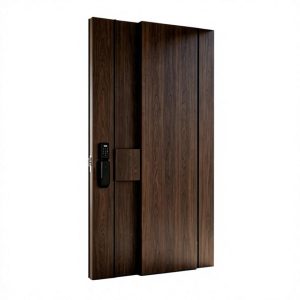
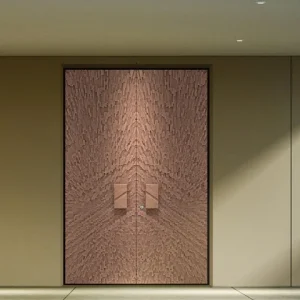
Hidden doors — sometimes called invisible or concealed doors — sit flush with the wall surface. When closed, they read as part of the wall, creating a seamless architectural line. These systems require specialized engineering:
- Heavy-duty 3D concealed hinges: Rated for 100,000+ open/close cycles, with adjustment in three axes (height, lateral, compression).
- Hidden aluminum frames: Provide structural support and integrate with drywall systems. The frame must be installed before drywall finishing.
- Precision tolerances: Door-to-frame gaps are typically 2–3mm, compared to 5–8mm for standard doors. This demands CNC machining and careful quality control.
B2B impact: Hidden door systems require close coordination between the door manufacturer, the wall framing contractor, and the finishing crew. This is not a product category for a supplier who cannot hold tight tolerances or communicate clearly across time zones.
2. Wood Species & Veneer Selection for Modern Interiors
The wood species and veneer cut determine the visual character of a modern door. For contemporary interiors, the choice is often narrow.
2.1 Rift-Cut Oak: The Modern Standard
Rift-cut oak is the dominant material in contemporary interior door collections. The rift cut minimizes the flake pattern in the grain, producing a straight, uniform appearance that suits minimalist and Scandinavian design languages.
Why it dominates: The straight grain reads as clean and architectural. It pairs well with both warm and cool interior palettes. White oak is the preferred species, with natural or lightly toned finishes.
Procurement note: Rift-cut veneer yields are lower than plain-sliced — roughly 30–40% of the log produces rift-grade veneer. This impacts cost. Buyers should confirm:
- Veneer matching method: Book-match (mirror image) or slip-match (repeated grain). Book-match is more visually striking but uses more veneer.
- Veneer grade: A-grade (clean, uniform), B-grade (minor color variation), or C-grade (more defects). Specify the grade clearly in your purchase order.
2.2 Other Species for Modern Aesthetics
| Species | Visual Character | Typical Finish | Best For |
|---|---|---|---|
| Walnut | Dark, rich, warm | Natural, matte lacquer | Luxury residential, executive offices |
| Maple | Light, subtle grain | Painted, white-washed | Scandinavian, minimal interiors |
| Ash | Prominent grain, textured | Natural oil, matte lacquer | “Textured” modern looks |
| Mahogany | Deep reddish-brown, fine grain | Stained, satin finish | Traditional-modern hybrid designs |
| Thermally Modified Wood | Uniform dark color, enhanced stability | Natural oil | High-humidity areas, exterior-adjacent interiors |
2.3 Veneer vs. Laminate vs. Real Wood
| Factor | Real Wood Veneer | Laminate | Solid Wood |
|---|---|---|---|
| Durability | Good (depends on finish) | Excellent (scratch-resistant) | Good (depends on finish) |
| Cost | Medium | Low | High |
| Aesthetic authenticity | High | Low–Medium | Very High |
| Dimensional stability | Good (with stable substrate) | Excellent | Poor (natural movement) |
| Environmental certifications | FSC available | CARB Phase 2 compliant | FSC available |
For modern interiors, real wood veneer over an engineered core provides the best balance of aesthetics, stability, and cost. Laminate reads as synthetic up close, and solid wood introduces movement risk that complicates flush installations.
3. Modern Design Features & Hardware Integration
Modern interior wood doors are defined as much by their hardware and profiles as by the wood itself.
3.1 Flush Doors & Minimalist Profiles
Flush doors have no visible stiles or rails — the face is one continuous plane. This design requires:
- Flatness tolerance: The door face must be flat within 1–2mm to avoid visible distortion under raking light.
- Edge banding quality: The edge treatment must match the face veneer precisely. Poorly matched edges are visible from 1 meter away.
- Finish consistency: Paint or lacquer must be applied evenly across the entire face — any variation is immediately noticeable on a flush surface.
3.2 Concealed Hinges & Hidden Frames
Three-dimensional concealed hinges are standard on modern doors. Key specifications:
- Load rating: A solid oak door needs hinges rated for 50kg+ per pair. Standard concealed hinges are rated 30–40kg.
- Adjustment range: Height adjustment of ±2mm, lateral adjustment of ±2mm, and compression adjustment of ±1.5mm.
- Cycle testing: Look for hinges tested to 100,000+ cycles (BS EN 1935 standard). [2]
Hidden aluminum frames add structural rigidity and allow the door to sit flush with the finished wall. The frame profile must match the wall construction — steel stud, wood stud, or masonry — which is why customization capability matters.
3.3 Glass Integration
Modern interior doors increasingly incorporate glass panels — fixed, operable, or sidelight configurations.
Glass types:
- Clear tempered glass: Maximum light transmission.
- Frosted or satin glass: Privacy with light diffusion.
- Reeded or fluted glass: Decorative texture, popular in modern residential projects.
- Wired glass: Fire-rated applications.
Safety compliance: Confirm tempered glass meets local standards — EN 12150 in Europe, ANSI Z97.1 in North America. [3] For doors with large glass panels, the frame must be reinforced to handle the additional weight and stress.
3.4 Digital Selection Tools
When sourcing through digital platforms, look for suppliers with mature e-commerce systems — including “recently viewed items” functions and design filters. This indicates a level of operational maturity that translates to better order tracking and specification management for bulk projects.
4. Finish Options: Painted, Stained, and Natural
The finish determines both the appearance and the longevity of the door. Factory-applied finishes are consistently superior to job-site finishing.
4.1 Factory Finishing vs. Job-Site Finishing
| Factor | Factory Finish | Job-Site Finish |
|---|---|---|
| Consistency | High (controlled conditions) | Variable (humidity, dust, temperature) |
| Durability | High (UV-cured or catalyzed) | Medium (air-dried) |
| Cost | Included in door price | Additional labor + material |
| Lead time | Adds 5–10 days | No production impact |
| Quality risk | Low | High (contractor skill dependent) |
For B2B projects, factory finishing is strongly recommended. The cost difference is offset by reduced on-site labor and lower defect risk.
4.2 Common Finish Systems
- UV-Cured Lacquer: Cured instantly under UV light. High scratch resistance, excellent for high-traffic commercial interiors. Typically 2–3 coats.
- Conversion Varnish: A two-part finish with excellent moisture resistance. Common in hospitality projects.
- Natural Oil Finishes: Penetrating oils that enhance the wood grain. Popular for rift-cut oak. Requires periodic maintenance — suitable for residential or low-traffic spaces.
- Matte vs. Satin: Modern design preference is matte (10–20% gloss). High-gloss finishes are rare in contemporary interiors.
4.3 Color Matching & Customization
The ability to match a specific RAL, NCS, or Pantone color is essential for large projects. Always request a physical finish sample (A4 panel) before full production. Digital images are not reliable for color matching — screen calibration varies, and wood grain affects how color reads.
5. A B2B Procurement Framework: Evaluating Interior Modern Wood Door Suppliers
Wooden doors are not always the cheapest option. For high-humidity areas, buyers should prioritize moisture resistance over appearance. With that caveat in mind, here is a structured framework for supplier evaluation.
5.1 Manufacturing Capability & Capacity
Questions to ask:
- What is the monthly production capacity for solid wood and engineered doors?
- Do you operate CNC machining centers? Precision hardware routing (for concealed hinges) requires CNC, not manual joinery.
- What is the maximum door height and width you can produce? Oversized doors (up to 3 meters) are increasingly common in modern projects.
Why it matters: Modern door designs — hidden doors, oversized panels, complex glass integration — require advanced machining capability. A supplier with only standard joinery equipment cannot deliver these products.
5.2 Quality Control & Pre-Shipment Inspection
Key standards:
- ISO 9001: Quality management systems. [4]
- FSC Chain of Custody: Confirms wood is sourced from certified sustainable forests. [5]
- CARB Phase 2: Formaldehyde emission limits for composite panels. [6]
Pre-shipment inspection protocols for interior doors:
- Moisture content: Should be 8–12% for most regions. Higher or lower indicates improper conditioning.
- Flatness test: Measure across the door face with a straightedge. Tolerance should be ≤2mm.
- Finish adhesion test: Cross-cut tape test per ASTM D3359. [7]
- Dimensional accuracy: Width, height, and thickness relative to specification. Tolerance should be ±1mm.
- Hardware function: Hinge operation, latch alignment, and closing force.
5.3 Customization Capabilities (OEM & ODM)
- OEM (Original Equipment Manufacturing): The supplier produces to your exact drawings and specifications.
- ODM (Original Design Manufacturing): The supplier designs and produces, and you brand it.
Key customization points for interior modern wood doors:
- Size (width, height, thickness)
- Wood species and veneer match
- Finish color (RAL, NCS, Pantone)
- Glass type and configuration
- Hardware cutouts (concealed hinges, locksets, etc.)
- Frame profiles (including hidden aluminum frames)
5.4 Sampling & Prototyping Process
Always request pre-production samples before bulk commitment:
- A4 finish panels: 7–15 days to produce. Confirm color, grain, and finish texture.
- Full-size door prototype: 20–30 days. Confirm dimensions, hardware integration, and installation fit.
A supplier who resists sampling is a red flag. Sampling is the only reliable way to verify quality claims.
5.5 Documentation & Compliance
For international shipments, the supplier should provide:
- Packing list
- Proforma invoice
- Certificate of origin
- Customs documentation (for FCL and LCL shipments)
Inaccurate documentation causes customs delays, which cascade into construction schedule slippage.
6. Key Quality Indicators for Interior Modern Wood Doors Buyers
Beyond the basics, experienced buyers look for these indicators:
6.1 Veneer Quality
- Grain consistency: Within a single order, veneer should come from the same log or closely matched logs. Color variation across doors is a common defect in low-cost manufacturing.
- Joint quality: Veneer joints should be tight (≤0.5mm gap) and invisible from 1 meter distance.
- Surface defects: Check for blisters, delamination, or sanding marks under raking light.
6.2 Core Quality (For Engineered Doors)
- Core density: Higher density cores (HDF > 800kg/m³) provide better screw-holding and impact resistance.
- Core moisture: Should match the veneer moisture to prevent delamination.
- Edge quality: The edge banding must be properly adhered — lifting edges indicate poor adhesive application.
6.3 Finish Durability
- Scratch resistance: Test with a coin or key across the surface. A quality finish should not scratch easily.
- Chemical resistance: Test with common cleaning agents (alcohol, acetone). The finish should not soften or discolor.
- UV stability: For doors near windows, confirm the finish has UV inhibitors to prevent yellowing.
6.4 Hardware Integration
- Hinge alignment: When open, the door should stay in position without drifting.
- Latch alignment: The latch should engage smoothly without forcing.
- Closing speed: For doors with closers, the speed should be adjustable and consistent.
7. Relevant Industry Standards and Certifications
Buyers should verify compliance with these standards:
| Standard | Scope | Relevance |
|---|---|---|
| ISO 9001 | Quality management systems | Overall manufacturing quality |
| FSC | Sustainable forestry | Wood sourcing legitimacy |
| CARB Phase 2 | Formaldehyde emissions | Composite panel safety |
| EN 1935 | Hinge testing | Hardware durability |
| EN 12150 | Tempered glass safety | Glass integration |
| ANSI Z97.1 | Safety glazing | Glass impact resistance |
| ASTM D3359 | Adhesion testing | Finish quality |
| BS EN 1534 | Wood flooring (adaptable) | Surface hardness |
8. Our Doors Manufacturing Capabilities
This is how the industry standards translate into our manufacturing approach at Jusen Door and Windows Manufacturing Co., Ltd.
8.1 Precision Manufacturing for Modern Door Systems
Our production line is configured to handle both solid wood and engineered door construction, including the hidden door systems that define contemporary interiors. CNC machining centers ensure the tight tolerances (±1mm) required for flush installations. For projects specifying concealed hinges and hidden aluminum frames, we produce the door body and frame as an integrated system — not as separate components that may not align on site.
8.2 Customization Without Middleman Markup
Because we are the factory, full customization — size, wood species, veneer match, finish color, glass type, and hardware selection — is offered without the markup of a trading company or distributor. This matters for architects and developers who need a specific aesthetic at a competitive price. Whether you specify rift-cut white oak with a matte lacquer finish or walnut with natural oil, the door is built to your specification, not adapted from a standard catalog product.
8.3 Quality Assurance & Compliance
Our pre-shipment inspection process includes dimensional checks, flatness testing, and finish adhesion verification. For international projects, we provide complete documentation — packing lists, proforma invoices, and customs paperwork — to ensure smooth FCL or LCL delivery from our China factory to your project site. Adjustable profile structures and fittings allow us to adapt doors to meet local building codes, fire ratings, and hardware standards across different markets.
9. Production Process: From Raw Material to Finished Doors
Understanding the production timeline helps buyers plan procurement schedules.
Stage 1: Material Conditioning (3–7 days)
Raw lumber is stored in climate-controlled conditions to bring moisture content to 8–12%. This prevents post-installation movement. Engineered cores are inspected for density and moisture consistency.
Stage 2: Machining & Core Preparation (5–10 days)
CNC machines cut the core to final dimensions, route hinge pockets and lock cutouts, and prepare the frame components. For engineered doors, veneer is applied under heat and pressure in a membrane press.
Stage 3: Veneer & Assembly (3–5 days)
Veneer is matched, applied, and trimmed. Door bodies are assembled with internal framing and reinforcements for hardware.
Stage 4: Finishing (5–10 days)
Doors move through the finishing line — sanding, staining or painting, and applying protective coats. UV-cured finishes cure in seconds, allowing multiple coats in a single day.
Stage 5: Hardware Installation (2–3 days)
Hinges, locksets, and concealed systems are installed. Adjustments are made to ensure proper alignment.
Stage 6: Final Inspection & Packing (2–3 days)
Each door is inspected against the specification sheet. Approved doors are packed with foam corner protectors, shrink wrap, and cardboard layering. Glass-integrated doors receive wooden crates.
Total production lead time: 25–45 days depending on finish and customization level.
10. Quality Control: Our Multi-Stage Inspection Process
Quality control is a process, not a final check. Our inspection occurs at multiple stages:
- Incoming material inspection: Lumber moisture, veneer grade, core density.
- In-process inspection: After machining, after veneer application, after finishing.
- Pre-shipment inspection: Dimensional accuracy, flatness, finish adhesion, hardware function.
For international orders, we can arrange third-party inspection before shipment. This provides independent verification for buyers who cannot visit the factory.
11. Customization and OEM/ODM Options
For B2B buyers, the procurement question is: “Can this supplier produce exactly what I need, or do I have to compromise?”
OEM: You provide the drawings and specifications. We produce to your exact requirements, including your branding if needed.
ODM: We design and produce based on your requirements. You brand the product as your own.
Customization points covered:
- Size: Up to 3 meters height, custom widths
- Wood species: Oak, walnut, maple, ash, mahogany, thermally modified
- Finish: RAL, NCS, Pantone matching; UV lacquer, conversion varnish, natural oil
- Glass: Clear, frosted, reeded, wired; tempered to local standards
- Hardware: Concealed hinges, hidden frames, locksets, sliding systems
12. Ordering Process: MOQ, Lead Time, and Shipping
12.1 Minimum Order Quantity (MOQ)
- Standard designs: MOQ of 10–50 units
- Fully custom doors (special veneer matching, unique hardware): 50+ units
- Sample orders: 1–2 doors for evaluation
MOQs exist because veneer matching, finish consistency, and hardware sourcing require batch production. A factory that claims no MOQ for custom doors is likely producing without proper quality control.
12.2 Lead Time
| Stage | Duration |
|---|---|
| Finish samples | 7–15 days |
| Full prototype | 20–30 days |
| Production (standard) | 25–35 days |
| Production (custom) | 35–45 days |
| Sea freight (China to major ports) | 20–40 days |
Plan for a 2–3 week buffer for customs clearance and inland transport.
12.3 Shipping: FCL vs. LCL
- FCL (Full Container Load): Best for 100+ doors. Lower per-unit cost, less handling damage. Strongly preferred for modern wood doors due to edge damage and finish scratching risks.
- LCL (Less than Container Load): Suitable for samples or smaller orders. More handling, higher damage risk, longer transit times.
13.
Frequently Asked Questions
What is the difference between solid wood and solid core interior doors?
Solid wood doors are constructed entirely from natural timber, offering premium aesthetics and acoustic performance but requiring more maintenance due to natural movement. Solid core doors feature an engineered core (HDF/MDF) with a real wood veneer, providing better dimensional stability, lower cost, and more consistent flatness — making them ideal for modern flush designs.
Can interior modern wood doors be customized to non-standard sizes?
Yes. Most factory-direct manufacturers offer full size customization. Oversized doors (up to 3 meters in height) are increasingly common in modern residential and commercial projects. Confirm the maximum dimensions and the impact on hinge selection and shipping costs before ordering.
What is the typical MOQ for factory-direct modern wood doors?
For standard designs, MOQs typically range from 10 to 50 units. For fully custom doors — special veneer matching, unique hardware, custom colors — MOQs are often higher, around 50 units or more. Sample orders of 1–2 doors are usually available for evaluation before bulk commitment.
How do I ensure the finish color will match my interior design?
Request a physical finish sample (A4-sized panel) before production. Factory-applied finishes are more consistent than job-site finishing because they are applied in controlled humidity and dust-free environments. Provide a physical reference — RAL color chip, NCS code, or material sample — rather than relying on digital images.
What are the key quality checks for interior modern wood doors?
Five checks matter most: (1) Moisture content at 8–12%, (2) Flatness within 2mm across the face, (3) Finish adhesion via tape test, (4) Dimensional accuracy within ±1mm, and (5) Hardware function — hinge operation and latch alignment. Reputable manufacturers perform these checks before shipment and provide inspection documentation.
How long does it take to receive a bulk order of modern wood doors?
Standard production lead time is 25–45 days depending on customization and finish. Add 20–40 days for sea freight from China to major international ports. For urgent projects, expedited production is sometimes available at additional cost. Plan for a 2–3 week buffer for customs clearance and inland transport.
14. How to Choose: Decision Guide
Choose solid core doors if:
- You need consistent flatness for flush, minimalist designs
- Fire ratings are required
- Budget predictability matters more than absolute authenticity
- The project involves large quantities (50+ doors)
Choose solid wood doors if:
- The project demands authentic natural timber construction
- Climate-controlled storage is available before installation
- Acoustic performance is critical
- The budget allows for premium materials and potential maintenance
Choose a factory-direct supplier if:
- You need customization beyond standard sizes and finishes
- The project volume justifies container shipment (100+ doors)
- You want to eliminate middleman markup
- You require OEM/ODM capabilities
Choose a distributor if:
- You need less than container-load quantities
- You need local inventory and immediate availability
- The project timeline cannot accommodate production lead times
References
[1] Fire Rated Doors: Standards and Testing. UL Solutions. https://www.ul.com/services/fire-rated-doors
[2] BS EN 1935:2002 Building hardware. Single-axis hinges. Requirements and test methods. BSI Group. https://knowledge.bsigroup.com/products/building-hardware-single-axis-hinges-requirements-and-test-methods
[3] ANSI Z97.1-2015: Safety Glazing Materials Used in Buildings. American National Standards Institute. https://webstore.ansi.org/standards/agrss/ansiz972015
[4] ISO 9001:2015 Quality management systems. International Organization for Standardization. https://www.iso.org/standard/62085.html
[5] FSC Chain of Custody Certification. Forest Stewardship Council. https://fsc.org/en/chain-of-custody-certification
[6] CARB Airborne Toxic Control Measure (ATCM) for Composite Wood Products. California Air Resources Board. https://ww2.arb.ca.gov/our-work/programs/composite-wood-products-program
[7] ASTM D3359-23 Standard Test Methods for Rating Adhesion by Tape Test. ASTM International. https://www.astm.org/d3359-23.html
—
If you are planning a project that requires modern wood doors — whether standard solid core or fully custom hidden door systems — we invite you to discuss your specifications with our team. We can provide samples, technical drawings, and a detailed quotation tailored to your project’s requirements.
https://doorwoodendoors.com/contact-us/” style=”display:inline-block;padding:12px 24px;background:#2563eb;color:#fff;text-decoration:none;border-radius:6px;font-weight:600″>Get a Free Quote