Content Menu
● 1. Understanding the Full View Front Door: Types and Applications
● 2. Full View Front Door Quality and Performance Factors
● 3. How to Evaluate Full View Front Door Suppliers
● 4. Key Quality Indicators for Full View Front Door Buyers
● 5. Relevant Industry Standards and Certifications
● 6. Our Door Manufacturing Capabilities
● 7. Customization and OEM/ODM Options
● 8. Ordering Process: MOQ, Lead Time, and Shipping
12 min read
A project manager for a high-end villa development once told me the hardest part of his job was not the structure. It was the entrance. Architects specified a nearly floor-to-ceiling glass door, but the first three suppliers he contacted could not guarantee the wind load resistance. The fourth one stopped answering calls after learning the size was custom.
Full view front doors are not complicated in concept. They are a door with a large, unobstructed glass panel. But they are demanding in execution. The frame must carry significant glass weight. The thermal performance must meet modern energy codes. The hardware must survive thousands of opening cycles. And because these doors are often the centerpiece of an entrance, the finish must be flawless.
This guide covers the technical specifications, procurement pitfalls, and supplier evaluation criteria that matter when sourcing these doors for commercial or residential projects. It is written for buyers, not homeowners.
Understanding the Full View Front Door: Types and Applications
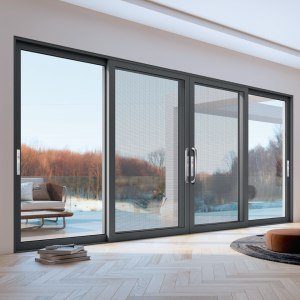
A full view front door is an entrance door system where glass occupies the majority of the visible surface—typically 80% or more of the total door area. Unlike a standard door with a small decorative glass insert, a full view design uses the glass panel as the primary structural and visual element.
Direct answer: A full view front door maximizes natural light and sightlines by using a large glass panel supported by a slim frame, typically aluminum or steel. It is specified in modern architecture for its aesthetic openness and is available in fixed, casement, sliding, or folding configurations.
The most common frame material for these doors is thermal-break aluminum. The reason is structural. A full-height glass panel can weigh 80–150 kg depending on size and glazing type. Aluminum extrusions with a wall thickness of 1.4–2.0 mm provide the rigidity needed to support that weight without sagging or twisting.
There are four primary configurations:
| Configuration | Opening Style | Best For | Trade-off |
|---|---|---|---|
| Fixed Panel | Non-opening | Maximum light and uninterrupted views | No ventilation |
| Casement | Hinged (inward or outward) | Ventilation with a classic swing door | Requires clearance for the swing arc |
| Sliding | Panels glide horizontally | Wide openings, space-efficient | Only half the opening is accessible at once |
| Folding (Bi-fold) | Panels stack to one side | Creating a completely open wall | More hardware points, higher cost |
Each configuration serves a different architectural purpose. A fixed panel is common in commercial storefronts. Casement doors are typical for residential entrances where homeowners want the option to open the door fully. Sliding and folding systems are specified for terraces, patios, and indoor-outdoor living spaces.
Full View Front Door Quality and Performance Factors
Quality in a full view front door is not visible from the outside. It is measured in performance under stress—wind pressure, water penetration, and thermal transfer.
Direct answer: Door quality is determined by four measurable factors: air tightness, water tightness, wind load resistance, and thermal insulation (U-value). These are tested under standardized conditions, and the results determine whether a door is suitable for a specific climate and building type.
Air Tightness
Measured in m³/(m²·h), air tightness indicates how much air leaks through the closed door assembly. A rating of Class 8 (the highest under EN 12207) allows less than 0.5 m³/(m²·h) of air leakage. Poor air tightness leads to drafts, energy loss, and dust infiltration. For a full view door with large glass panels, the seal between the glass and frame is often the weakest point.
Water Tightness
Measured in Pascals (Pa), water tightness is the pressure difference a door can withstand before water penetrates. A Class 9A rating under EN 12208 means the door withstands 600 Pa. This matters in regions with heavy rain and high winds. The frame must have an internal drainage system—small channels that collect and expel any water that enters the frame, preventing it from reaching the interior.
Wind Load Resistance
Measured in kPa, this is critical for large glass panels. A door rated for 2.0 kPa can withstand wind pressure of roughly 200 kg/m². For high-rise buildings or coastal areas, engineers often specify higher ratings. Wind load affects the required frame wall thickness, the number of reinforcement inserts, and the glass thickness.
Thermal Insulation (U-value)
The U-value, measured in W/m²K, indicates how much heat transfers through the door. Lower is better. A standard aluminum door without thermal break has a U-value around 5.8 W/m²K—poor insulation. A thermal-break aluminum door with double glazing and Low-E glass achieves 1.4–2.0 W/m²K. Triple glazing can bring it below 1.0 W/m²K, but adds significant weight.
Here is the honest caveat: chasing the lowest U-value is not always the right move. Triple glazing on a full view door can make the panels so heavy that you need reinforced hinges, a stronger frame, and potentially a floor spring mechanism. The added cost may not be justified in mild climates.
How to Evaluate Full View Front Door Suppliers
Most buyers evaluate suppliers based on price and sample quality. Both are important. Neither is sufficient.
Direct answer: The supplier evaluation framework has five pillars: technical capability, manufacturing process control, customization flexibility, documentation reliability, and logistics competence. A supplier that passes all five is likely to deliver consistent quality at scale.
Questions to Ask Before Ordering
- “What is your frame wall thickness, and can you increase it for larger panels?” A supplier who cannot adjust wall thickness may not handle custom sizes safely.
- “Do you test every unit or only samples?” Batch testing is common, but unit-level testing for air and water tightness is superior.
- “Can you provide a thermal break design with polyamide strips?” Not all aluminum doors have true thermal breaks. Some use cheaper PVC strips with lower insulation performance.
- “What is your MOQ for a custom RAL color?” If a project requires a specific color, the supplier must be able to justify the minimum quantity.
- “Can you provide a Proforma Invoice, Packing List, and Certificate of Origin?” For international buyers, missing documents cause customs delays and unexpected costs.
Avoid Suppliers Who…
- Only offer fixed sizes. A full view front door is rarely a standard size. If a supplier cannot customize, they cannot serve real projects.
- Cannot explain their drainage system. Water management inside the frame is essential. A supplier who cannot articulate how water exits the frame likely has not designed it properly.
- Quote hardware separately. Some suppliers quote a low frame price, then add expensive hardware costs later. Ask for a fully inclusive quote.
- Have no testing equipment on site. A supplier who outsources testing to a third party is not necessarily bad, but one who cannot test in-house has longer feedback loops for quality issues.
Choose A if… Choose B if…
- Choose a full-service manufacturer if your project involves custom sizes, specific performance requirements, or multiple door and window types. They can coordinate production and maintain consistent quality.
- Choose a trading company only if you need a very small quantity (1–2 doors) for a residential renovation and cannot meet a manufacturer’s MOQ. Expect to pay 10–20% more for the middleman service.
Key Quality Indicators for Full View Front Door Buyers
Beyond the performance ratings, there are visual and tactile indicators of quality that buyers can check without specialized equipment.
Direct answer: Key quality indicators include the uniformity of the powder coating finish, the precision of the mitre joints at the corners, the smooth operation of hinges and locks, and the consistency of the gasket installation. These are visible signs of manufacturing discipline.
- Corner joints: Run your finger over the corner where frame profiles meet. A gap or a sharp edge indicates poor cutting or assembly. High-quality corners are flush and seamless.
- Gasket alignment: The rubber gaskets that seal the glass should be continuous, with no visible kinks or gaps at the corners.
- Hardware feel: Open and close the door. It should move smoothly without binding. The locking mechanism should engage with a solid, positive click—not a loose rattle.
- Finish consistency: Look at the color and texture of the powder coating under direct light. Uneven color or visible orange peel texture indicates poor surface preparation or curing.
Relevant Industry Standards and Certifications
Full view front doors are tested and certified under regional standards. Knowing these helps buyers specify products correctly.
Direct answer: The most relevant standards are EN 14351-1 (European), NFRC and AAMA/WDMA/CSA 101/I.S.2/A440 (North American), and GB/T 8478 (Chinese national standard). Certification to these standards is evidence that a door has been tested for air, water, and wind performance.
| Standard | Region | What It Covers |
|---|---|---|
| EN 14351-1 | Europe | CE marking, air permeability, water tightness, wind load, thermal transmittance |
| AAMA/WDMA/CSA 101/I.S.2/A440 | North America | Performance class and grade for windows and doors |
| GB/T 8478 | China | Air permeability, water tightness, wind load for aluminum doors and windows |
| NFRC 100 | North America | U-factor and SHGC rating for fenestration |
For projects in hurricane-prone regions such as Florida, look for suppliers who can meet the Florida Building Code (TAS 201, TAS 202, TAS 203) impact and pressure testing requirements. For European projects, CE marking under EN 14351-1 is mandatory.
Our Door Manufacturing Capabilities
Here is how the industry works. Most international buyers source doors through trading companies based in major Chinese cities. These companies do not manufacture anything. They buy from factories, add a markup of 10–20%, and handle the export process. The buyer pays more, and the factory never learns the buyer’s actual requirements.
We operate differently. As a factory, we control the entire production chain—from aluminum profile cutting and thermal break assembly to glazing, hardware installation, and final testing. When you order from us, you are paying for the product, not the middleman.
Production Process: From Raw Material to Finished Door
The production process for a full view front door involves several precise stages:
- Profile cutting: Aluminum profiles are cut to length based on the door dimensions. For custom sizes, this is done per order, not from stock.
- Thermal break assembly: Polyamide strips are inserted between the inner and outer aluminum profiles, then crimped to create the thermal break.
- CNC machining: Holes for hinges, locks, and drainage channels are machined with CNC equipment. This ensures precision that manual drilling cannot match.
- Surface finishing: The frame is powder coated or finished with wood-grain foil transfer. RAL colors are matched to the client’s specification.
- Assembly: Profiles are joined, gaskets are installed, and the glass unit is fitted.
- Hardware installation: Heavy-duty hinges, multi-point locks, and handles are installed and adjusted.
- Testing: The finished door undergoes air tightness, water tightness, and wind resistance testing before packaging.
Quality Control: Our Multi-Stage Inspection Process
We do not rely on spot checks. Every unit is tested before it leaves our factory floor.
The inspection process covers:
- Dimensional accuracy: Door width, height, and squareness are measured against the approved drawings.
- Glass integrity: Each glass unit is checked for chips, scratches, and proper seal.
- Hardware function: Locks, hinges, and handles are operated multiple times to verify smooth function.
- Performance testing: Air tightness and water tightness tests are conducted on a sample basis per production batch, with records kept for client review.
The trade-off here is that unit-level testing takes time. It adds a few days to the production schedule. But for buyers who have experienced the cost of installing defective doors—labor, rework, and project delays—the wait is worth it.
Customization and OEM/ODM Options
Standard catalog products rarely match custom architectural plans. We offer full customization on size, color, glass type, and hardware accessories.
Direct answer: Customization options include frame size, profile color (RAL or wood-grain finishes), glass type (tempered, laminated, Low-E, double or triple glazing), and hardware brand and style. For larger projects, OEM and ODM partnerships are available, allowing buyers to brand the product and integrate specific design requirements.
The customization process works like this:
- You provide your architectural drawings or specify the dimensions.
- Our engineering team reviews the design and confirms the profile structure, wall thickness, and glass specification.
- We produce a sample for your approval (for large orders) or provide detailed technical drawings.
- Production begins after approval.
For buyers in regions with specific building codes, we adjust the profile structure and select fittings to match local requirements. This includes increasing wall thickness for high wind load areas, using specific glass types for safety compliance, and configuring the thermal break for colder climates.
Ordering Process: MOQ, Lead Time, and Shipping
Understanding the ordering process helps buyers plan their projects and avoid surprises.
Direct answer: For custom orders, the typical MOQ is 10–20 units depending on the size and complexity. Production lead time is 15–25 days after design approval, and shipping takes 20–35 days depending on the destination port. We support both FCL and LCL shipments.
MOQ
Standard sizes have a lower MOQ, sometimes as low as 5 units. Custom sizes and custom colors require a higher MOQ because the production line must be set up specifically for your order.
Lead Time
- Sample production: 7–10 days
- Custom order production: 15–25 days after approval
- Bulk order (100+ units): 30–40 days
Shipping and Documentation
We handle both FCL (full container load) and LCL (less than container load) shipments. For LCL shipments, we consolidate your order with other cargo to fill the container, which reduces your shipping cost but extends transit time slightly.
All export documentation is provided, including:
- Proforma Invoice
- Packing List
- Commercial Invoice
- Bill of Lading
- Certificate of Origin
Packaging
Doors are packaged with protective film on all visible surfaces, foam corner pads, and wooden crates for glass protection. For fragile glass panels, additional wooden reinforcement is added.
Certifications and Industry Standards
Our products are manufactured to meet the performance requirements of EN 14351-1 and GB/T 8478. For buyers targeting specific markets, we can adjust the production process to comply with local certification requirements.
Direct answer: We test our doors for air tightness, water tightness, and wind load resistance in-house. For specific project requirements, we can coordinate third-party testing to meet local certification standards such as CE marking or Florida Building Code compliance.
The cost of third-party certification is typically borne by the buyer, as it involves external testing fees and documentation. However, our engineering team assists with the technical documentation and product adjustments needed to pass these tests.
FAQ: Full View Front Doors
What is a full view front door?
A full view front door is an entrance door where glass constitutes the majority of the surface area, supported by a slim frame—usually thermal-break aluminum. It is designed to maximize natural light and provide an unobstructed view of the exterior.
How much does a full view front door cost?
At wholesale pricing, a thermal-break aluminum full view door typically ranges from $1,500 to $5,000+ per unit, depending on size, glass type, and hardware quality. Custom sizes and premium finishes increase the cost. Shipping and import duties are additional.
Is it safe to have a full view front door?
Yes, when properly specified. Modern full view doors use tempered or laminated safety glass, which is significantly stronger than standard glass. Multi-point locking systems and reinforced aluminum frames provide security comparable to solid doors.
What is a glass door in front of a front door called?
This is a storm door or security screen door. It is installed in front of the main entrance door to provide additional weather protection and security while allowing light through.
Can you match a specific RAL color?
Yes. Our powder coating line supports most standard RAL colors, and we offer wood-grain foil finishes that replicate the appearance of natural wood.
What is the difference between FCL and LCL shipping?
FCL (Full Container Load) means you rent an entire container for your order. LCL (Less than Container Load) means your order shares a container with other cargo. FCL is faster and more secure but costs more per shipment. LCL is cheaper for small orders but has longer transit times.
—
When you are sourcing a full view front door, you are not buying a product. You are buying a system that must perform under weather stress, meet building codes, and support the weight of large glass panels for decades. The supplier’s manufacturing discipline determines whether that system works.
We have built our production process around the standards discussed in this article—thermal-break aluminum profiles, multi-stage testing, and full customization. If you have a project that requires a specific size, performance rating, or finish, contact us with your drawings or specifications.
References
- European Committee for Standardization. “EN 14351-1:2006+A2:2016 – Windows and doors – Product standard, performance characteristics.” CEN, 2016. https://www.cen.eu/
- American Architectural Manufacturers Association. “AAMA/WDMA/CSA 101/I.S.2/A440-17 – North American Fenestration Standard.” AAMA, 2017. https://www.aamanet.org/
- National Fenestration Rating Council. “NFRC 100 – Procedure for Determining Fenestration Product U-factors.” NFRC, 2020. https://www.nfrc.org/
- Standardization Administration of China. “GB/T 8478-2020 – Aluminum alloy doors and windows.” SAC, 2020. https://www.sac.gov.cn/
- Florida Building Commission. “Florida Building Code, 8th Edition (2023) – Chapter 17: Structural Tests.” FBC, 2023. https://www.floridabuilding.org/