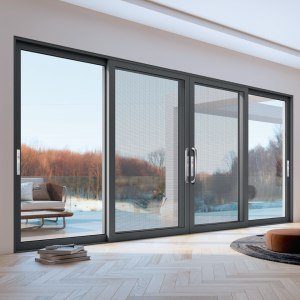
The Best Screen Door for French Doors: The Short Answer
For most French door openings, a retractable screen is the best screen door. It disappears into a slim housing when not in use, preserves the sightline through the double doors, and does not interfere with the swing of either leaf. Where the opening is recessed or the doors are inswing, a sliding screen panel on a top track is the more practical second choice. A hinged screen door is the right answer only when the opening is a single active leaf with a stationary second leaf, or when the frame is too shallow for a track system.
The reason retractable wins is mechanical, not aesthetic. French doors are two leaves in one frame, and each leaf swings through an arc. Any screen that occupies that arc — a hinged screen on the active leaf, or a full-width swinging screen — has to be coordinated with the door swing, the handle projection, and the threshold height. A retractable or sliding screen travels in its own plane, so the door leaves never touch it.
Storm doors are a different product category and should not be confused with screens. A storm door is an exterior add-on door with a full frame and glazing, fitted over an existing entry door to add insulation, weather protection, and a second locking point. On a French door pair, a storm door is only viable when one leaf is fixed or when the pair is treated as a single entry. Buyers searching for the best insulated storm door or the best storm doors for security are usually solving an entry-door problem, not a French-door ventilation problem. Separating these two needs is the first decision in this comparison.
Screen Door Types for French Doors: Retractable, Sliding, and Hinged
Each type solves the same problem — keeping insects out while letting air through — but they fail in different situations.
Retractable screens use a spring-tensioned mesh that pulls out from a vertical or horizontal housing and latches to a catch on the opposite side. For a French door pair, the housing is typically mounted on the jamb or on the face frame, and the mesh spans the full opening. Advantages: nothing blocks the view when retracted, no swing arc conflict, and a single unit covers a double opening. Limitations: the mesh tension degrades over time, the housing needs roughly 40–60 mm of mounting depth depending on the model, and repairs usually require replacing the whole cartridge rather than a single panel.
Sliding screen panels run on a top track with a bottom guide. They suit French doors where the opening has a level threshold and enough headroom for the track. A two-panel slider can cover a double opening, with one panel fixed and one sliding. Advantages: simple mechanism, easy to replace a single panel, good airflow. Limitations: the track collects debris, the bottom guide can be a trip point, and the fixed panel reduces the usable clear opening.
Hinged screen doors are the traditional option and still the most repairable. They work well when only one leaf opens regularly. Advantages: cheap to replace mesh, familiar hardware, strong frames. Limitations: the screen door swing must not collide with the French door swing, and on a true double-door opening you need either two hinged screens or one wide screen that swings across both leaves — both create clearance problems in narrow rooms.
Fitment: inswing vs outswing matters more than the type
Inswing French doors open into the room. A screen mounted on the interior face must sit outside the door’s swing arc, which usually means mounting it on the exterior face or using a retractable unit that travels in the frame plane. Outswing French doors open outward, so an interior-mounted screen has clear space — but an exterior storm door would collide with the leaves and is generally not an option.
A practical check before ordering: measure the distance from the door face to the nearest obstruction (wall return, furniture, radiator) and confirm it exceeds the screen’s housing depth plus the door leaf thickness. On recessed openings this is where most fitment failures happen.
Storm Door Comparison Table: Insulation, Security, and Quality
The table below compares the main categories buyers evaluate. Values are typical ranges for planning purposes; actual performance depends on the specific model, glass package, and installation quality.
| Category | Frame material | Typical insulation approach | Security features | Relative cost | Best suited to |
|---|---|---|---|---|---|
| Retractable screen (French doors) | Aluminum housing, fiberglass or polyester mesh | None (ventilation product) | Mesh only; latch optional | Low–mid | Double French openings, view preservation |
| Sliding screen panel | Aluminum frame, fiberglass mesh | None | Panel latch, no lock | Low | Level thresholds, wide openings |
| Hinged screen door | Wood or aluminum, removable | None | Light latch | Low | Single active leaf |
| Aluminum storm door, basic | Aluminum, single glazing | Air gap only | Basic latch, single lock | Low–mid | Mild climates, budget entry |
| Aluminum storm door, insulated | Thermal-break aluminum, double glazing | Foam-filled frame, low-E glass | Multi-point lock, reinforced strike | Mid | Cold or hot climates, main entries |
| Steel storm door | Galvanized steel, foam core | Foam core, double glazing | Heavy frame, deadbolt-ready | Mid–high | Security-priority entries |
| Full-view storm door | Aluminum or steel, tempered glass | Depends on glass package | Laminated or tempered glass, multipoint | High | Entries where light and security both matter |
Two things the table cannot show. First, insulation performance in a storm door is dominated by the glass package and the seal, not the frame material — a foam-filled frame with single glazing underperforms a thermal-break frame with a proper double-glazed low-E unit. Second, security in a storm door is mostly about the frame’s resistance to prying and the quality of the strike plate, not the lock cylinder alone.
How to Choose the Best Insulated Storm Door
Insulation claims on storm doors are frequently overstated because the door is only one part of the assembly. A storm door adds a dead air space and a second barrier, which reduces heat loss through the entry and cuts drafts. How much it helps depends on four components.
Glass package. Single glazing provides an air gap and little else. Double glazing with a low-E coating and argon fill is the meaningful upgrade. Tempered glass is required in many jurisdictions for doors and sidelights because of impact and safety — check local requirements rather than assuming.
Frame construction. A thermal break separates the interior and exterior faces of the frame so heat does not conduct straight through the metal. Foam-filled frames add rigidity and reduce condensation on the interior face in cold weather. Condensation on the inside of a storm door frame is the most common complaint in cold climates and is usually a thermal-break or seal problem, not a glass problem.
Seals and sweep. The weatherstripping around the perimeter and the sweep at the bottom do more for real-world performance than the frame’s nominal rating. Replaceable bulb or blade seals are worth specifying because they wear out before the door does.
Installation and the host door. A storm door over a poorly sealed or warped entry door will not fix the entry. The host door’s own weatherstripping and threshold must be sound first.
For buyers comparing the best insulated storm doors, the practical test is to ask for the glass specification, the frame construction (thermal break yes/no, foam fill yes/no), and whether the perimeter seal is replaceable. Those three answers separate genuine insulated units from cosmetic ones.
Security and Brand Reviews: What Buyers Should Know
Security on a storm door is a layered problem. The weakest point is almost never the lock cylinder — it is the frame, the strike, and the glazing.
A security-oriented storm door typically has a reinforced frame that resists spreading under prying, a strike plate anchored into the frame rather than the trim, and multi-point locking that engages the frame at more than one height. Tempered or laminated glass matters because a full-view door with annealed glass offers no real barrier. Laminated glass holds together after impact and is the better choice where break-in resistance is the goal; tempered glass is stronger against blunt impact but shatters into small pieces when it fails.
On brand landscape: the storm door market is dominated by a small number of large manufacturers whose products are sold under both their own names and private labels at building supply retailers. This matters for buyers reading reviews, because the same door can appear under several brand names with different price points and warranty terms. The practical consequence is that “who makes the best storm doors” is often better answered by comparing the specific model’s frame, glass, and hardware specification than by brand reputation alone.
What reviews consistently reveal, across brands:
- Fit and finish complaints cluster around out-of-square frames and misaligned hinges, which are often installation issues rather than manufacturing defects.
- The most common long-term failure is the closer — pneumatic closers lose damping and cause slamming, which then damages the frame.
- Condensation and seal degradation appear repeatedly in cold-climate reviews, and are usually traceable to a missing thermal break or a worn sweep.
- Hardware finish corrosion shows up in coastal and high-humidity markets, where stainless or coated hardware is worth specifying.
Reviews are useful for identifying failure patterns. They are weak evidence for insulation or security performance, because almost no reviewer measures either. For those two attributes, the specification sheet is the better source.
Buying Guide: Sizing, Codes, and Installation for French Doors
Measuring the opening
Measure the width at three points — top, middle, and bottom — and the height at three points, then use the smallest figure. French door openings are rarely perfectly square, and a screen or storm door ordered to the largest dimension will not fit. For a double opening, confirm whether you are covering the full pair or only the active leaf; the two require different products.
For retractable units, the critical dimensions are the clear opening width and the available mounting depth on the jamb or face. For sliding panels, add the track height to the headroom requirement. For storm doors, measure the frame opening rather than the door slab, and confirm the hinge side and swing direction before ordering. A dedicated size guide is worth consulting before finalizing dimensions, and it is worth checking current pricing bands before committing to a specification.
Clearance and swing
Check three clearances: the screen or storm door swing against the French door swing, the handle projection against the screen housing, and the bottom sweep against the threshold height. A threshold that rises more than about 15 mm above the interior floor will interfere with many bottom sweeps and guides.
Codes, egress, and permissions
Doors in a sleeping room or on an egress path must meet local egress requirements for clear opening width and height. Adding a screen or storm door must not reduce the clear opening below the required minimum, and a storm door must not block the operation of the primary door from the inside. Rental agreements and historic-district rules frequently restrict exterior additions and visible hardware — confirm before ordering, because custom-sized doors are usually non-returnable.
Installation and maintenance
Screen doors for French doors are usually a two-person job because the housing or track must be held level while fastening. No-drill mounting options exist for renters: tension-fit or adhesive-backed retractable housings, and clamp-on tracks, though these carry lower wind and pet-load ratings than fastened systems. Maintenance is minimal — clean tracks, check mesh tension seasonally, and replace sweeps and seals when they harden. Storm door closers should be adjusted seasonally; a closer that slams is the leading cause of frame damage.
Pets and durability
Mesh strength, not frame strength, determines pet durability. Standard fiberglass mesh is the weakest option. Heavier-duty polyester or vinyl-coated mesh resists claw and paw damage far better, and replaceable mesh cartridges or panels are worth prioritizing if pets use the door daily. On hinged screens, a pet-resistant mesh with a reinforced bottom rail lasts considerably longer than a standard assembly.
Supplier Evaluation for B2B Buyers: Customization and Logistics
For project buyers, distributors, and contractors sourcing screen and storm doors in volume, the specification questions above become supplier questions. The variables that decide whether a container arrives usable are customization capability, documentation, and inspection discipline.
On customization: French door openings vary by market, and a supplier that can adjust profile structure, frame depth, and hardware to match the target market’s building codes reduces on-site modification. Full customization across size, color, glass, and hardware is the baseline expectation for project supply, not an upgrade.
On documentation: importers need a packing list, proforma invoice, and complete customs documentation that match the actual shipment. Mismatches between the packing list and the container contents are a common cause of clearance delays.
On quality control: for doors and windows, the meaningful pre-shipment checks are air-tightness, water-tightness, and wind resistance testing. A supplier that runs these before loading is catching problems at the factory rather than at the job site.
This is the framework we work to at Jusen Door and Windows. We supply directly from our factory, which removes middleman markup, and we build to the buyer’s specification rather than to a fixed catalog — adjustable profile structure and fittings so the product matches local building codes in the destination market, and full customization on size, color, glass, and hardware. Pre-shipment, we run air-tightness, water-tightness, and wind resistance testing, and we handle the export paperwork — packing list, proforma invoice, and customs documents — as part of the order. We ship both FCL and LCL direct from the factory, which matters for buyers whose first order is smaller than a full container.
If you are specifying screen or storm doors for a French door project, Talk to Our Team with your opening dimensions, target market, and quantity, and we can confirm what is feasible before you commit.
Final Recommendations and Next Steps
Choose a retractable screen if you have a double French opening, want to preserve the view, and have at least 40–60 mm of mounting depth. Choose a sliding panel if the opening has a level threshold and you want the simplest mechanism to maintain. Choose a hinged screen if only one leaf opens and repairability matters most.
For storm doors: choose a thermal-break aluminum unit with double low-E glazing if insulation is the priority; choose a steel or reinforced-frame unit with laminated glass and multi-point locking if security is the priority; choose a full-view model if you need both and are willing to pay for the glass package.
Before ordering anything, measure the opening at three points, confirm the swing direction of the French doors, check egress and rental or HOA restrictions, and verify the glass and frame specification in writing rather than relying on the marketing description. That sequence prevents the two most expensive mistakes in this category: a door that does not fit the opening, and a door that fits but does not perform.
When you are ready to specify, Get a Free Quote and we will work from your dimensions and destination market.