Key Takeaways: What to Know Before Buying
A black front door with glass panels is one of the most effective ways to modernize an entryway, but the buying decision comes down to three core variables: the door material, the glass specification, and the finish quality.
Here is the short version of what matters:
- Material determines longevity and maintenance. Fiberglass offers the best balance of durability and insulation for most climates. Wood provides premium aesthetics but requires regular refinishing. Steel is the most secure and affordable but dents and conducts heat.
- Glass is a performance component, not just a design feature. The difference between a single-pane decorative insert and a double-pane low-E unit is significant for both energy bills and security. Tempered or laminated glass is a safety requirement, not an upgrade.
- Black finishes vary in durability. Factory-applied finishes on fiberglass and steel are baked on and last for years. Painted wood requires a high-quality exterior-grade paint and periodic maintenance.
- Cost is driven by material, size, and glass configuration. Expect a wide range from entry-level steel doors to premium wood or aluminum systems. Installation and customization add to the total.
Material Comparison: Wood, Fiberglass, and More
The material of your black front door with glass panels determines everything from thermal performance to how often you will repaint it. Here is how the main options compare.
Wood Front Door with Glass Panels
Wood remains the benchmark for aesthetic warmth. A black-painted wood door with glass panels offers a classic, high-end look that is hard to replicate.
However, wood is the most demanding material in terms of upkeep. A black finish on wood is particularly challenging because dark colors absorb more heat, which accelerates the expansion and contraction of the wood. This can lead to paint cracking or peeling faster than on a lighter color.
- Pros: Premium appearance, high resale value, can be custom-carved or shaped, natural insulation properties.
- Cons: Requires repainting or refinishing every 2–3 years depending on exposure, susceptible to warping and moisture damage, generally the most expensive option.
- Best for: Projects where aesthetics are the primary driver and a maintenance schedule is acceptable.
Fiberglass Front Doors with Glass Panels
Fiberglass is the most practical modern choice for a black exterior door. The material is dimensionally stable, does not warp or rot, and the factory finish is highly durable.
A quality fiberglass door is molded to mimic wood grain, and once painted, it is difficult to distinguish from real wood at a distance. The key advantage is that the black finish is typically baked into a gel coat or applied with a UV-cured process, which resists fading and chalking far better than field-applied paint.
- Pros: Excellent insulation (especially with polyurethane foam cores), low maintenance, resists dents and scratches, holds paint well.
- Cons: Less authentic texture than real wood up close, limited custom carving options, the finish cannot be easily changed later without professional refinishing.
- Best for: Most residential and commercial projects requiring durability and energy efficiency with minimal upkeep.
Steel Front Doors with Glass
Steel offers the highest security at the lowest price point. A steel door with glass panels is a common choice for budget-conscious projects or side entrances.
The main limitation is thermal performance. Steel is a conductor, so the door frame and edges can transfer heat and cold. Modern steel doors use a foam core and thermal breaks to mitigate this, but they still underperform fiberglass in extreme climates.
- Pros: Most affordable, high impact resistance, easy to paint, fire-resistant properties.
- Cons: Dents and dings are permanent, prone to rust if the finish is scratched, poor insulation unless well-engineered, black finishes can fade faster due to heat absorption.
- Best for: Security-focused projects in moderate climates or budget-constrained builds.
Aluminum and Thermal-Break Options
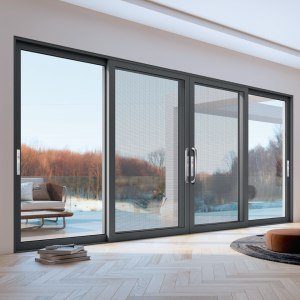
Aluminum is less common for residential front doors but is a strong contender for commercial projects or modern architectural styles. A black aluminum door with glass panels offers a slim profile that maximizes glass area.
The critical specification to look for is a thermal-break design, where a polyamide strip separates the interior and exterior aluminum frames. Without this, aluminum is the worst insulator of all options.
- Pros: Very slim sightlines (more glass, less frame), extremely durable, corrosion-resistant, ideal for large custom sizes.
- Cons: More expensive than steel, thermal performance depends entirely on the quality of the thermal break, interior condensation can occur if the break is poor.
- Best for: Modern architectural projects, large custom entryways, or commercial storefronts.
Glass Panel Options: Style, Light, and Efficiency
The glass in a black front door is not just a decorative insert — it is a structural and thermal component. Here is what you need to specify.
Clear Glass
Clear glass maximizes natural light and provides a clean, modern look. The trade-off is privacy and security. Anyone can see inside, and clear glass is the easiest to break.
If you choose clear glass, it must be tempered or laminated. Tempered glass shatters into small, blunt pieces rather than sharp shards. Laminated glass holds together when broken, providing a higher level of security.
Frosted and Obscured Glass
Frosted glass, also known as etched or obscured glass, allows light transmission while blocking visibility. This is the standard choice for front doors where privacy is a concern.
The level of privacy varies by the etching pattern. Some patterns obscure completely, while others only blur shapes. For a front door, a medium-level obscurity is usually sufficient — you want to see movement and light, but not details.
Decorative and Patterned Glass
Decorative glass includes beveled, stained, or patterned designs. These are often used in traditional or craftsman-style homes. While visually appealing, decorative glass can be harder to clean and may reduce energy efficiency if it is a single-pane design.
Low-E and Insulated Glass
This is the most important technical specification. Low-E (low-emissivity) glass has a microscopic metallic coating that reflects heat back toward its source. In winter, it keeps interior heat inside. In summer, it reflects exterior heat away.
For a front door, specify double-pane (insulated) glass with a low-E coating. This combination provides:
- Better insulation: The air gap between panes acts as a thermal barrier.
- Reduced condensation: The interior pane stays closer to room temperature.
- UV protection: Low-E coatings block a significant portion of UV rays, protecting interior furnishings and preventing the black door finish from fading.
The U-factor measures how well the glass prevents heat transfer. Lower is better. The SHGC (Solar Heat Gain Coefficient) measures how much solar heat passes through. For a door facing west or south, a lower SHGC is preferable to reduce heat buildup.
Double Doors vs. Single Doors with Glass
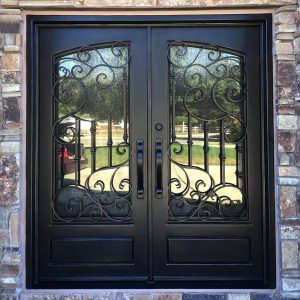
Double front doors with glass panels make a strong architectural statement. They are the standard choice for larger homes, luxury villas, and commercial entrances.
The cost difference is substantial. A double door system requires two door slabs, a larger frame, and potentially a more complex header to support the wider opening. You are typically looking at 1.5 to 2 times the cost of a single door.
The benefits go beyond aesthetics:
- Wider passage: Allows moving large furniture or equipment in and out easily.
- Natural light: Two doors mean more glass area and significantly more daylight in the entryway.
- Ventilation: Both doors can open fully for cross-ventilation on mild days.
The trade-offs include:
- More maintenance: Two doors mean two sets of hinges, locks, and weatherstripping to maintain.
- Sealing challenges: The center meeting stile where the two doors close is a potential air and water leak point. A high-quality system with a proper astragal (the vertical strip that seals the gap) is essential.
- Security: Two doors create two potential entry points. Ensure both doors have robust locks, and consider a fixed panel configuration where one door is stationary.
Horizontal Glass Panels: A Modern Design Choice
The horizontal glass panel trend is one of the most distinctive developments in entry door design. Instead of a traditional rectangular insert or a full glass panel, the glass is divided into horizontal bands or strips.
This design serves a specific function: it provides a sightline at eye level while maintaining privacy and structural integrity lower down. A door with horizontal glass panels typically has:
- A solid lower section (often 30–40% of the door height).
- One or more horizontal glass strips across the upper portion.
This configuration is popular in contemporary and mid-century modern architecture. It creates a strong visual line that complements flat, minimalist facades.
From a practical standpoint, horizontal glass panels offer:
- Privacy: The lower portion of the door is solid, so occupants are not visible when seated or when small children are near the door.
- Light control: The glass is positioned to capture light at a higher angle, reducing glare.
- Design flexibility: The number, width, and position of the glass strips can be customized to match the proportions of the building.
The main consideration is security. A door with a horizontal glass panel that spans the full width of the door requires a reinforced frame around the glass to maintain structural rigidity. Ensure the glass is laminated and the frame is reinforced at the glass edges.
Comparison Table: Black Front Door with Glass Panels by Material
| Attribute | Wood | Fiberglass | Steel | Aluminum (Thermal-Break) |
|---|---|---|---|---|
| Price Range | Highest | Mid-to-high | Lowest | High |
| Insulation (R-value) | Good (R-5 to R-7) | Excellent (R-7 to R-10) | Poor to fair (R-3 to R-5) | Good (R-5 to R-8) |
| Maintenance | High (repaint every 2–3 years) | Low (clean periodically) | Medium (touch-up scratches) | Low (clean periodically) |
| Customization | High (carving, custom sizes) | Medium (molded textures, sizes) | Low (limited designs) | High (slim profiles, custom sizes) |
| Durability | Susceptible to moisture and pests | Resists dents, moisture, and warping | Dents easily, prone to rust | Excellent corrosion resistance |
| Security | Good (depends on lock) | Good (depends on lock) | Excellent (inherent strength) | Good (depends on lock and glass) |
| Best For | Premium aesthetics | Most residential and commercial projects | Budget and security-focused builds | Modern architecture, large openings |
How to Choose the Right Front Door for Your Project
The decision framework depends on your project’s priorities. Here is a practical approach.
Climate Considerations
For projects in extreme climates — either very cold or very hot — prioritize fiberglass or thermal-break aluminum. The insulation performance of the door and glass directly impacts HVAC loads. A steel door in a northern climate will feel cold to the touch and may develop condensation issues.
For moderate climates, material choice matters less for energy and more for maintenance and aesthetics.
Orientation and Sun Exposure
A black door facing south or west absorbs significant solar heat. This affects the door finish and the glass performance.
- South-facing: The black finish will fade faster. Choose a fiberglass door with a UV-stable factory finish. Specify low-E glass with a low SHGC to reduce heat gain.
- North-facing: The door receives little direct sun. The priority shifts to insulation (U-factor) to retain interior heat. Condensation on the interior glass is more likely in winter, so double-pane glass is essential.
- East-facing: Morning sun exposure. A standard low-E coating is sufficient.
Security Requirements
For projects where security is a primary concern, follow this hierarchy:
- Steel provides the most impact resistance.
- Fiberglass with a solid core is a close second.
- Wood and aluminum depend entirely on the lock hardware and glass specification.
Regardless of material, specify:
- Multi-point locking systems: These lock the door at multiple points along the frame, not just at the handle. They resist forced entry significantly better than a single deadbolt.
- Laminated glass: This is the strongest glass option. It holds together when shattered, making it much harder to breach.
- Reinforced frames: The frame must be as strong as the door. A steel door in a weak wooden frame offers little security.
Cost Budgeting
The total cost of a black front door with glass panels includes more than the door slab. Budget for:
- The door unit (slab, frame, weatherstripping).
- Glass upgrade (double-pane, low-E, laminated).
- Hardware (handle, locks, hinges).
- Installation (professional installation is recommended for exterior doors).
- Custom sizing or finish (if not a standard size).
As a general rule, the door unit itself is 50–60% of the total project cost. Installation and hardware make up the rest.
FAQ: Answering Your Top Questions
What are the pros and cons of wood vs. fiberglass front doors with glass panels?
Wood offers superior aesthetics and a premium feel but requires regular refinishing and is vulnerable to moisture. Fiberglass offers nearly the same appearance with significantly lower maintenance and better insulation. For most projects, fiberglass is the more practical choice, but wood remains the choice for high-end residential work where appearance trumps upkeep.
What type of glass is best for an exterior front door?
The best specification is double-pane, low-E glass with a laminated inner pane. This combination provides insulation, UV protection, and security. If budget is a constraint, prioritize tempered glass for safety but understand that laminated glass is significantly more secure.
Are double front doors with glass panels worth the extra cost?
Double doors are worth the cost when the entryway is a focal point of the building and the wider opening provides functional benefits like natural light or furniture access. For projects where the goal is simply a secure, attractive entrance, a single door with a side lite (a fixed glass panel beside the door) achieves a similar look at a lower cost.
How do horizontal glass panels affect the look and function of a front door?
Horizontal glass panels create a modern, linear aesthetic that suits contemporary architecture. Functionally, they provide privacy at the lower portion of the door while allowing light in at eye level and above. They are an excellent choice for projects where full glass is too exposed but a solid door is too dark.
What is the average price range for a black front door with glass panels?
Pricing varies significantly by material, size, and glass specification. Entry-level steel doors with a single glass insert start in the low hundreds. Fiberglass doors with double-pane glass typically range from mid-hundreds to over a thousand dollars. Premium wood or custom aluminum doors can exceed several thousand dollars. Installation adds a significant portion to the total.
How do I maintain a black front door to prevent fading or peeling?
The key is to start with a quality factory finish. For fiberglass and steel, clean the door periodically with mild soap and water to remove dirt and pollutants that accelerate fading. For wood, use a high-quality exterior-grade paint or stain and plan to refinish every 2–3 years. Avoid using pressure washers, which can force water into the door’s joints and under the finish.
Can I customize the size and design of a front door with glass panels?
Yes, most manufacturers offer custom sizing and design options. Customization typically includes door dimensions, glass panel configuration, glass type (clear, frosted, decorative), hardware style, and color finish. For projects with non-standard openings, custom doors are often the only option.
Additional Considerations: Supplier and Manufacturing Insights
The topics above cover what to buy. The following covers how to buy it — specifically, how to evaluate a supplier when you are sourcing doors for a project, whether you are a contractor, a builder, or a homeowner managing a renovation.
The Case for Factory-Direct Sourcing
When you compare quotes from different suppliers, you are often comparing the same factory’s product sold through different channels. A distributor adds a markup for warehousing, sales, and logistics. A factory-direct supplier removes that layer.
This is not about “cheaper” — it is about control. When you work directly with the manufacturer, you specify the exact profile, glass configuration, and hardware. You also get direct access to the people who know the product’s limitations and capabilities. If a project requires a non-standard size or a specific thermal performance rating, a factory can tell you what is achievable and what is not.
What to Verify with a Supplier
Regardless of who you source from, verify these points before committing:
- Test reports: Ask for air-tightness, water-tightness, and wind-resistance test reports. These are standard for exterior doors and windows in most regulated markets.
- Glass certification: Confirm that the glass meets local safety standards (tempered or laminated as required by building codes).
- Customization capability: If you need a specific size or a unique glass configuration, confirm the factory can produce it without compromising structural integrity.
- Shipping and documentation: For international orders, confirm the supplier can provide the necessary export documentation, packing lists, and proforma invoices.
How We Approach This at Jusen Door and Windows
As a manufacturer of thermal-break aluminum doors and windows, system windows, and custom villa doors, our approach is straightforward: we build what the project requires, and we verify it before it ships.
Here is how we meet the standards discussed in this article:
- Full customization: We handle custom sizes, colors, glass types (clear, frosted, low-E, laminated), and hardware accessories. The profile structure and fittings can be adjusted to match local building codes in your target market.
- Pre-shipment inspection: Every order undergoes air-tightness, water-tightness, and wind-resistance testing before it leaves our factory. This is not an optional extra — it is part of our standard process.
- Direct factory supply: Because we are the factory, you are not paying for a middleman’s markup. You also get direct access to our engineers for technical questions about installation and specification.
- Export experience: We regularly ship FCL and LCL from China, with full customs documentation, packing lists, and proforma invoices handled in-house.
If you are specifying a black front door with glass panels for a project and need a manufacturer that can meet your exact specifications, we are set up to do that.
Or reach out directly to our team to discuss your project requirements.