Content Menu
● 1. Understanding Exterior French Doors 5: Types and Applications
● 2. Exterior French Doors 5 Quality and Performance Factors
● 3. How to Evaluate Exterior French Doors 5 Suppliers
● 4. Key Quality Indicators for Exterior French Doors 5 Buyers
● 5. Relevant Industry Standards and Certifications
● 6. Production Process: From Raw Material to Finished 5’0″ French Door
● 7. Quality Control: Our Multi-Stage Inspection Process
● 8. Ordering Process: MOQ, Lead Time, and Shipping
13 min read
When a contractor orders a 5’0″ exterior French door unit for a renovation, the first measurement they take is the rough opening. Not the door slab, not the frame — the hole in the wall. Get that wrong and nothing else matters.
The 5’0″ width (60 inches nominal) sits in a practical middle ground. It is wide enough to move furniture through, narrow enough to fit standard header heights without structural modification. For builders and distributors, it is one of the most frequently specified double-door sizes in residential and light commercial work.
This guide covers what procurement professionals need to know before placing an order: dimensional standards, material behavior, glass performance, inspection protocols, and how to evaluate suppliers who claim they can deliver.
Understanding Exterior French Doors 5: Types and Applications
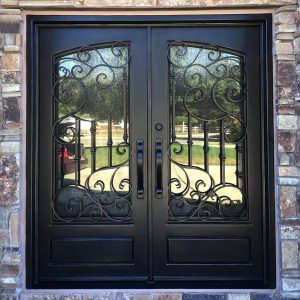
A 5’0″ exterior French door is a double-door unit with a nominal finished opening width of 60 inches. Each leaf measures approximately 30 inches wide, though exact slab dimensions depend on the frame style and whether the unit is prehung or slab-only.
The 5’0″ configuration serves several project types:
- Residential renovations — replacing sliding glass doors with hinged French doors for a more traditional look.
- Tract housing — standard 5’0″ openings in production homes where cost efficiency matters.
- Light commercial — restaurants, offices, and retail spaces requiring a wide entry without going to a full 6’0″ commercial door system.
- Accessibility upgrades — the 5’0″ opening provides 32+ inches of clear passage when one leaf is active, meeting ADA clearance requirements in many configurations.
Why 5’0″ Is a Standard Opening Width
The 5’0″ double door aligns with common framing conventions. In North American construction, standard stud spacing and header sizes accommodate a 60-inch rough opening without custom engineering. The typical rough opening for a 5’0″ prehung unit ranges from 61.5″ to 62″ wide and 81.5″ to 82″ tall for a 6’8″ door height.
Common height pairings:
| Door Height | Rough Opening Height | Typical Header |
|---|---|---|
| 6’8″ (80″) | 81.5″ – 82″ | Standard single header |
| 7’0″ (84″) | 85.5″ – 86″ | Extended header |
| 8’0″ (96″) | 97.5″ – 98″ | Structural header required |
The 5’0″ width works with each of these heights, though taller units require stiffer materials to prevent sagging over time.
Key Specification Points Buyers Must Verify
Three measurements define a prehung door unit:
- Rough opening — the framed hole in the wall.
- Frame size — the outer dimensions of the door frame, typically 1/2″ to 3/4″ smaller than the rough opening on each side.
- Door slab size — the actual door leaf, which sits inside the frame with a 1/8″ to 3/16″ clearance on the hinge and strike sides.
Buyers also need to verify jamb width. A 2×4 wall requires a 4-9/16″ jamb; a 2×6 wall requires a 6-9/16″ jamb. Some manufacturers offer adjustable jambs that accommodate both.
Swing direction matters for egress. In most jurisdictions, exterior doors must swing inward for residential applications, but commercial buildings may require outswing for emergency egress. Check local codes before ordering.
Common Configurations in the 5’0″ Class
The 5’0″ double door comes in several glazing patterns:
- Full-lite — one large glass panel per leaf, maximizing natural light and views.
- 6-lite — three vertical lites per leaf, a classic French door look.
- 10-lite and 12-lite — more divided lites for traditional or historic projects.
- 15-lite — the most divided option, common in period renovations.
Material choice affects how these configurations perform. Fiberglass handles wide spans with minimal sag. Aluminum thermal-break profiles offer slim sightlines for full-lite designs. Wood provides traditional aesthetics but requires more maintenance.
Exterior French Doors 5 Quality and Performance Factors
A 5’0″ double door spans a wider opening than a standard single door. That width creates structural demands that single doors don’t face. The center meeting stile, the hinge reinforcement, and the frame rigidity all determine whether the door stays square over years of use.
Material Comparison: Fiberglass, Aluminum, and Wood
Fiberglass dominates the exterior residential market for good reason. A fiberglass door with a polyurethane foam core provides:
- Dimensional stability across temperature swings
- Paintability with standard exterior paints
- Resistance to rot, warping, and insect damage
- U-factors as low as 0.15 in insulated configurations
The 5’0″ width with a full-lite design works well in fiberglass because the skin material doesn’t sag or twist the way solid wood can.
Thermal-break aluminum is the preferred choice for commercial and modern architectural projects. The thermal break — a polyamide strip separating the interior and exterior aluminum profiles — reduces condensation and heat transfer. These doors offer:
- Slim sightlines for maximum glass area
- High wind load resistance (tested to ASTM E330)
- Custom powder-coated colors
- Low maintenance over decades of use
Solid wood remains the premium option for historic renovations and high-end residential work. Mahogany, oak, and pine are common species. Wood doors require periodic refinishing and careful weatherstripping, but they offer a warmth that synthetic materials can’t replicate.
Performance Metrics That Matter
Buyers should request test reports for three performance categories:
| Test Standard | What It Measures | Typical Pass Criteria |
|---|---|---|
| ASTM E283 | Air infiltration | ≤ 0.3 cfm/ft² |
| ASTM E547 | Water penetration | No leakage at test pressure |
| ASTM E330 | Structural wind load | No permanent deformation |
NFRC ratings provide comparable thermal performance data:
- U-factor — heat transfer rate; lower is better (0.20–0.30 for good insulated doors)
- SHGC — solar heat gain coefficient; lower for hot climates, higher for cold climates
- VT — visible transmittance; higher means more natural light
A door with a low U-factor but poor air infiltration numbers will still feel drafty. Evaluate the whole assembly, not just individual ratings.
How to Evaluate Exterior French Doors 5 Suppliers
The supplier evaluation process separates serious manufacturers from resellers. The questions you ask — and the documentation you request — determine whether your 5’0″ door order arrives on spec or becomes a field modification problem.
Request These Documents Before Ordering
Every reputable supplier should provide:
- Cut sheets with exact dimensions for the 5’0″ unit, including jamb width, slab thickness, and meeting stile details.
- Installation instructions that match the unit’s actual construction.
- Third-party test reports for air, water, and structural performance — not self-certified data.
- Warranty terms in writing, including what’s covered and for how long.
If a supplier can’t produce test reports, ask why. In many cases, they’re reselling another manufacturer’s product and don’t have the documentation.
Red Flags to Avoid
- No physical factory address — a supplier that only operates through email and a website may be a trading company with no manufacturing control.
- Vague answers on lead times — a manufacturer knows their production schedule; a reseller doesn’t.
- No customization capability — if the supplier only offers fixed sizes and configurations, they likely don’t control the production line.
- Pressure to pay in full upfront — standard terms for bulk orders are typically 30% deposit, 70% before shipment.
Choose A if… Choose B if…
Choose a factory-direct manufacturer if: you need custom sizes, specific glass packages, or private labeling. You want to eliminate middleman markup. You require direct communication with the engineering team.
Choose a distributor if: you need immediate availability of a standard product, you’re ordering small quantities, or you want a local warranty contact. Distributors add value through inventory and logistics — not through manufacturing expertise.
Key Quality Indicators for Exterior French Doors 5 Buyers
Beyond test reports, several quality indicators predict whether a 5’0″ door unit will perform in the field.
Frame construction: Look for kiln-dried frame material or thermally broken aluminum profiles. A frame that twists after installation creates alignment problems that no adjustment can fix.
Hardware grade: Multi-point locking systems distribute force across the door height, preventing warping and improving security. Standard single-point deadbolts are acceptable for interior use but underperform on exterior double doors.
Weatherstripping: Magnetic or compression seals outperform simple bulb weatherstripping. Check that the meeting stile has a proper astragal — the vertical seal between the two doors — to prevent air and water infiltration at the center seam.
Glass edge support: The glazing bead and setting blocks must support the glass properly. Poor edge support leads to glass stress cracks, especially in large full-lite panels on wide doors.
Questions to Ask Before Ordering
- What is the AQL (acceptable quality limit) for your pre-shipment inspection?
- Can you provide photos or video of the actual units before shipment?
- What is your defect replacement policy?
- How do you handle transit damage claims?
- Can you adjust the profile structure to meet our local building codes?
Relevant Industry Standards and Certifications
The door and window industry operates on established testing protocols. Buyers should know which standards apply to their market.
North America:
- AAMA/WDMA/CSA 101/I.S.2/A440 — the combined standard for windows and doors
- NFRC 100 — thermal performance rating procedure
- ASTM E283, E547, E330 — air, water, and structural tests
Europe:
- EN 14351-1 — the harmonized standard for windows and doors
- CE marking — required for sale in the EU
International:
- ISO 9001 — quality management system certification
- ISO 14001 — environmental management
A manufacturer with export experience will know which standards apply to your destination market. They should adjust their profile structure and fittings accordingly — not ship a product built for a different region.
Production Process: From Raw Material to Finished 5’0″ French Door
Understanding how a 5’0″ French door is manufactured helps buyers identify quality differences between suppliers.
Aluminum Thermal-Break Door Production
- Profile extrusion — aluminum billets are heated and forced through dies to create the frame profiles.
- Thermal break insertion — polyamide strips are inserted between interior and exterior profiles, then crimped or poured and cured.
- Cutting and machining — profiles are cut to length, and hinge, lock, and drainage holes are machined.
- Assembly — frames are assembled, and corner keys are inserted and crimped.
- Glass unit fabrication — insulated glass units are assembled with low-E coatings and argon fill.
- Glazing — glass is set into the frame with setting blocks and glazing beads.
- Hardware installation — hinges, locks, handles, and weatherstripping are installed.
- Quality inspection — each unit is checked for squareness, hardware function, and seal integrity.
Fiberglass Door Production
- Molding — fiberglass skins are compression-molded to the door design.
- Core assembly — polyurethane foam is injected between the skins and allowed to cure.
- Trimming — the door slab is trimmed to exact dimensions.
- Priming — a factory primer coat is applied for field painting.
- Glazing and hardware — glass and hardware are installed per the order.
The key quality difference between manufacturers shows up in step 8 — inspection. A factory that tests air-tightness, water-tightness, and wind resistance before shipment catches problems that would otherwise surface on the job site.
Quality Control: Our Multi-Stage Inspection Process
As a factory-direct manufacturer of solid wood, thermal-break aluminum, and fiberglass doors, our approach to the 5’0″ exterior French door category follows the framework outlined above. We don’t just assemble components — we engineer the profile structure and fittings to match the building codes and performance requirements of your destination market.
Our pre-shipment inspection covers three critical tests:
- Air-tightness testing — verifying that the assembled door meets the specified air infiltration rate.
- Water-tightness testing — subjecting the door to simulated rain and wind pressure to confirm no water penetration.
- Wind resistance testing — confirming the door structure can withstand the specified wind load without permanent deformation.
These tests align with ASTM E283, E547, and E330 protocols. For buyers who need third-party verification, we coordinate independent testing at your request.
Customization and OEM/ODM Options
The 5’0″ width is our starting point, not our limit. Our engineering team works from your cut sheets or rough opening dimensions to deliver prehung units that fit on the first try.
Customization options include:
- Size — any width or height beyond the standard 5’0″ configuration
- Color — custom powder coating for aluminum, custom paint for fiberglass and wood
- Glass — low-E coatings, tempered or laminated glass, triple-pane configurations
- Hardware — multi-point locks, specific handle sets, custom hinges
- Private label — your brand on the product and packaging
OEM and ODM support means we can modify existing designs or engineer new ones to meet project-specific performance targets.
Ordering Process: MOQ, Lead Time, and Shipping
Bulk buyers need predictable timelines. Here’s what to expect when ordering 5’0″ exterior French doors from our factory.
MOQ and Pricing
Minimum order quantities depend on the product type. For standard fiberglass and aluminum units, MOQs start at container-load quantities. Custom sizes and finishes may require higher MOQs due to production setup.
Our pricing reflects factory-direct economics — no middleman markup. The price you see includes the manufacturing cost, not a distributor’s margin. For project quotes, we provide line-item pricing so you can see exactly what you’re paying for.
Lead Times
| Order Type | Production Lead Time |
|---|---|
| Standard sizes, standard finish | 3–4 weeks |
| Custom sizes or custom colors | 4–6 weeks |
| Fully bespoke designs | 6–8 weeks |
Shipping adds 2–5 weeks depending on destination. We recommend building a 2-week buffer into your project schedule for inspection and transit delays.
Shipping Modes
We ship both FCL (full container load) and LCL (less than container load) directly from our China factory.
- FCL — cost-effective for bulk orders. A 40′ container holds approximately 80–100 prehung 5’0″ double door units depending on packaging.
- LCL — suitable for smaller orders. You pay for the volume you use, but consolidation introduces handling risk.
Every shipment includes a packing list, proforma invoice, and full customs documentation prepared in-house. Our foreign trade experience ensures your order moves through customs without documentation delays.
Certifications and Industry Standards
Our quality management system follows ISO 9001 principles. We test our products to the standards relevant to your market — whether that’s AAMA/WDMA/CSA for North America, EN 14351-1 for Europe, or local standards for other regions.
When you request a quote, we’ll confirm which standards apply to your project and ensure the profile structure and fittings meet those requirements.
—
What is the best brand for exterior French doors?
The “best” brand depends on your project requirements. Fiberglass offers low maintenance and good insulation. Thermal-break aluminum provides slim sightlines and high wind resistance. Wood delivers premium aesthetics with higher maintenance. For bulk buyers, a factory-direct manufacturer offers competitive pricing and customization that retail brands can’t match. Evaluate suppliers on test reports, customization capability, and warranty terms — not just brand recognition.
What sizes do exterior French doors come in?
Standard double-door widths include 5’0″ (60″), 5’6″ (66″), and 6’0″ (72″). Standard heights are 6’8″, 7’0″, and 8’0″. The 5’0″ width is common for residential and light commercial applications. Custom sizes are available from manufacturers with in-house engineering.
Are French doors good for exterior use?
Yes, when properly specified. Choose fiberglass or thermal-break aluminum for exterior exposure. Verify low-E insulated glass and check air and water tightness ratings. Wood doors work but require periodic refinishing. The meeting stile seal (astragal) is critical for preventing air and water infiltration.
How much should exterior French doors cost?
Retail prices for fiberglass 5’0″ double doors typically range from $1,500 to $4,000. Thermal-break aluminum units vary widely based on finish and performance requirements. Wood is often the premium option. Factory-direct pricing for bulk orders is typically 20–40% lower than retail, before freight and duties.
What is the lead time for bulk orders of 5’0″ exterior French doors?
Typical production lead time is 4–8 weeks depending on customization level. Standard sizes ship faster than custom designs. FCL shipping adds 2–5 weeks depending on destination. Plan production and transit into your project schedule with a buffer for inspection.
Can I order custom sizes beyond the standard 5’0″ width?
Yes. Manufacturers with in-house engineering can produce custom widths and heights. Provide your rough opening dimensions and performance requirements for a precise quote. Custom sizes typically require a higher MOQ and longer lead time than standard units.
What documents do I need for importing doors from China?
A packing list, proforma invoice, bill of lading, and certificate of origin are standard. Suppliers with foreign trade experience provide these and guide you through customs documentation. Ensure your supplier can produce these documents accurately — errors cause delays and additional costs.
—
The 5’0″ exterior French door is a versatile standard opening, but the supplier you choose determines whether it performs as intended. Verify material performance, glass options, inspection protocols, and logistics capability before committing to an order.
Work with a factory that can customize, test, and document — not just a reseller. The right manufacturing partner makes the difference between a door that fits on the first try and a field modification problem.
For bulk orders, custom sizes, or OEM/ODM projects, request a quote with your specifications and we’ll confirm the details — including test reports, lead times, and shipping costs.
—
References
- AAMA/WDMA/CSA 101/I.S.2/A440 — North American Fenestration Standard. https://www.aamanet.org/
- ASTM E283 — Standard Test Method for Determining Rate of Air Leakage Through Exterior Windows, Skylights, Curtain Walls, and Doors Under Specified Pressure Differences Across the Specimen. https://www.astm.org/e0283-19.html
- ASTM E330 — Standard Test Method for Structural Performance of Exterior Windows, Skylights, Curtain Walls, and Doors by Uniform Static Air Pressure Difference. https://www.astm.org/e0330-14.html
- ASTM E547 — Standard Test Method for Water Penetration of Exterior Windows, Skylights, Doors, and Curtain Walls by Cyclic Static Air Pressure Difference. https://www.astm.org/e0547-16.html
- NFRC 100 — Procedure for Determining Fenestration Product U-factors. https://www.nfrc.org/
- EN 14351-1 — Windows and doors. Product standard, performance characteristics. https://www.cen.eu/