Content Menu
● 1. What Is a Glass Modern Front Door?
● 2. What Are the Main Types of Glass Modern Front Doors?
● 3. What Glass Types Are Used in Modern Front Doors?
● 4. What Performance Metrics Matter for a Glass Modern Front Door?
● 5. How Much Does a Glass Modern Front Door Cost?
● 6. How to Evaluate Glass Modern Front Door Suppliers
● 7. What Are the Red Flags When Evaluating Suppliers?
● 8. Choose A Supplier If… Choose B Supplier If…
● 9. Our Manufacturing Approach
● 10. Production Process: From Raw Material to Finished Door
12 min read
The first question a contractor asks when specifying a glass modern front door is rarely about the glass. It is about the frame. A beautiful glazed entrance that leaks air or sags under wind load becomes a callback within eighteen months. The second question is about the glass itself — not the look, but the laminated interlayer, the Low-E coating position, and the U-value. This guide walks through those technical decisions from a procurement perspective, then explains how to evaluate factories that build these doors at scale.
What Is a Glass Modern Front Door?
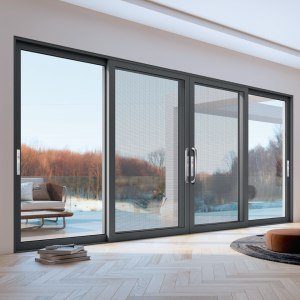
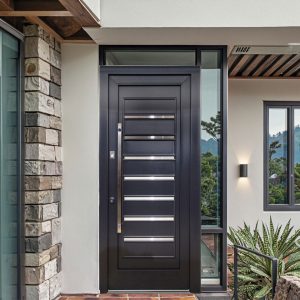
A glass modern front door is a primary entry door constructed with a large glazed panel or panels, typically framed in aluminum, steel, or engineered wood. Unlike a storm door — which is a secondary protective layer installed in front of a solid door — a glass modern front door serves as the main entrance itself. The “modern” designation refers to the design language: minimalist frames, slim sightlines, flush thresholds, and expansive glass surfaces that maximize natural light while maintaining structural performance.
The distinction matters for B2B buyers. A storm door is an accessory. A glass modern front door is a building envelope component subject to air infiltration testing, water penetration testing, and wind load calculations.
What Are the Main Types of Glass Modern Front Doors?
The market segments into four primary configurations, each suited to different project requirements.
| Configuration | Frame Material | Best For | Typical Glass Area |
|---|---|---|---|
| Single glass panel | Thermal-break aluminum | Modern minimalist homes, showrooms | 60–80% of door area |
| Double door with side-lites | Aluminum or steel | Large entryways, commercial lobbies | 50–70% of total width |
| Partial glass with solid base | Aluminum with insulated panel | Privacy-conscious residential | 30–50% of door area |
| Full glass pivot door | Heavy-duty aluminum or steel | Architectural statements, luxury villas | 80–95% of door area |
The frame material dictates the maximum glass size. Standard aluminum profiles without thermal breaks limit glass panels to roughly 900mm width before deflection becomes visible. Thermal-break aluminum — where a polyamide strip separates the interior and exterior metal — allows panels up to 1200mm or wider while maintaining structural rigidity.
What Glass Types Are Used in Modern Front Doors?
The glass is the most misunderstood component of a front door. Buyers often specify “double glazing” without understanding the three distinct performance layers: safety, thermal efficiency, and aesthetics.
Safety and Security Glazing
Tempered glass is the legal minimum for door glazing in most jurisdictions. When broken, it shatters into small, relatively harmless pebbles rather than dangerous shards. However, tempered glass does not remain in the frame when broken — it falls out, creating a security gap.
Laminated glass is the B2B standard for entry doors. A polyvinyl butyral (PVB) or ethylene-vinyl acetate (EVA) interlayer bonds the glass layers together. When broken, the fragments adhere to the interlayer, maintaining the door’s integrity. For front doors, specify a minimum of 6mm + 6mm laminated construction. This provides burglary resistance — a determined intruder with a hammer needs several minutes to penetrate laminated glass, versus seconds for tempered.
Energy Efficiency Glass
Low-Emissivity (Low-E) glass has a microscopic metallic oxide coating that reflects long-wave infrared radiation. In winter, it reflects interior heat back into the building. In summer, it blocks solar heat gain. The coating position within the insulated glass unit matters — a coating on surface 2 (the interior face of the outer pane) optimizes winter performance, while surface 3 (the exterior face of the inner pane) optimizes summer performance.
Argon or krypton gas fills the cavity between panes. Argon is the industry standard for cost-effectiveness, reducing U-values by approximately 10–15% compared to air-filled units. Krypton performs better but costs significantly more — it is typically reserved for triple-glazed configurations where cavity widths are narrow.
Aesthetic and Privacy Glass
Frosted or acid-etched glass offers privacy without sacrificing natural light. Sandblasting creates a uniform matte finish, though it can be difficult to clean. Acid etching produces a smoother, more durable finish. Decorative interlayers — metal mesh, fabric, or film sandwiched within laminated glass — add architectural interest while maintaining the security benefits of lamination.
Tinted and reflective glass reduces solar heat gain and glare while creating a uniform building facade. The tradeoff is reduced visible light transmission. For a glass modern front door with a south-facing orientation, a tinted outer pane combined with a Low-E coating is often the optimal specification.
What Performance Metrics Matter for a Glass Modern Front Door?
Beyond aesthetics, a front door must perform to measurable standards. These metrics are the language of procurement — the specifications that separate a quality door from a liability.
Air Tightness
Air infiltration is measured in cubic meters per hour per square meter of opening area at a standardized pressure differential. Chinese national standard GB/T 7106 defines eight levels, with Level 8 being the highest performance. A quality glass modern front door should achieve Level 6 or above. Poor air tightness leads to drafty interiors, energy loss, and condensation at the frame edges.
Water Tightness
Water penetration resistance is tested under simulated wind-driven rain. The standard defines six levels based on the pressure differential at which water penetrates the interior. For coastal or high-wind regions, specify Level 4 or above. Doors with inadequate water tightness develop leaks at the threshold and hinge corners during storms.
Wind Load Resistance
The frame must withstand the pressures generated by wind without permanent deformation. This is particularly critical for high-rise buildings and coastal projects. The test applies increasing pressure to the door surface while measuring deflection. A thermal-break aluminum frame with proper reinforcement can handle significantly higher wind loads than standard aluminum profiles.
Thermal Performance (U-value)
The U-value measures heat transfer through the entire door assembly — frame, glass, and hardware. For a glass modern front door with thermal-break aluminum framing and double-glazed Low-E glass, a U-value of 1.0–1.5 W/m²K is achievable. Triple-glazed configurations can reach 0.8 W/m²K or lower. Passive House certification requires door U-values below 0.8 W/m²K.
How Much Does a Glass Modern Front Door Cost?
Wholesale pricing for glass modern front doors varies substantially based on configuration. For B2B buyers purchasing directly from a manufacturer, expect the following ranges:
| Configuration | Wholesale Price Range (per unit) |
|---|---|
| Standard aluminum frame, double-glazed, tempered glass | $500–$800 |
| Thermal-break aluminum frame, double-glazed, Low-E glass | $800–$1,500 |
| Thermal-break frame, triple-glazed, laminated Low-E glass | $1,200–$2,000 |
| Custom pivot door, oversized glazing, premium hardware | $2,000–$4,000+ |
The frame material is the largest cost driver. Thermal-break aluminum adds approximately 20–30% over standard aluminum profiles. Triple glazing adds another 15–25% over double glazing. European multi-point locking hardware — brands like Hoppe, Roto, or GU — costs 3–5 times more than standard Chinese hardware but provides superior security and durability.
Custom sizes increase cost beyond the base unit price. A door that requires a non-standard extrusion or a unique glass cut introduces waste and additional setup time. For B2B projects, consolidating orders into standardized sizes — even only for the frame profiles — can reduce per-unit costs by 10–15%.
How to Evaluate Glass Modern Front Door Suppliers
Supplier evaluation requires a structured framework. The following criteria apply whether you are sourcing domestically or importing from overseas.
Manufacturing Capability Verification
Ask for production facility details: workshop square footage, number of production lines, annual output capacity. A manufacturer with multiple extrusion lines and automated cutting equipment can maintain consistent quality at scale. A supplier that outsources fabrication to third parties introduces quality variability that is difficult to control.
Request sample production before committing to a full order. The sample must be produced on the same production line with the same specifications as the bulk order — not a hand-assembled prototype. Discrepancies between sample and bulk production are the most common source of B2B disputes.
Quality Control Process
A serious manufacturer conducts pre-shipment inspections on every order, not just spot checks. The inspection should test air tightness, water tightness, and wind load resistance on finished doors — not just components. Request the inspection report format in advance, and verify that the testing equipment is calibrated and maintained.
Export Logistics Capability
For international buyers, the supplier’s ability to handle export documentation is critical. A factory that regularly exports to your region will have established relationships with freight forwarders, familiarity with your country’s customs requirements, and experience with the packing standards necessary to prevent transit damage.
Financial Stability Indicators
Request the supplier’s export records or bank reference. A manufacturer that has maintained export relationships with buyers in your region for multiple years signals financial stability and operational reliability. Avoid suppliers that demand full payment before production without providing a verifiable track record.
What Are the Red Flags When Evaluating Suppliers?
Several warning signs indicate a supplier that will cause problems:
Avoid suppliers who cannot provide test reports for the specific door model you are ordering. Test reports for a different model do not prove your configuration will perform.
Avoid suppliers whose minimum order quantity seems unusually low for a factory. A genuine manufacturer typically requires 20–50 units minimum. A supplier accepting single-unit orders is likely a trading company or a small workshop with limited capacity.
Avoid suppliers who quote significantly below market rates. A 30% discount from the market average indicates either lower-grade materials, reduced glass thickness, or compromised quality control. The cost difference will appear in callbacks and warranty claims.
Avoid suppliers who resist customization requests. A factory with in-house production can adjust profile structures and fittings to match your local building codes. A supplier that forces you into a standard catalog lacks manufacturing flexibility.
Choose A Supplier If… Choose B Supplier If…
The decision between a domestic distributor and a direct factory import depends on your project scale and timeline.
Choose a domestic distributor if:
- Your project requires delivery within 2–3 weeks
- Your order volume is under 10 units
- You need after-sales support with on-site visits
Choose a direct factory import if:
- Your project involves 20+ units or a multi-phase development
- You have 6–10 weeks of lead time available
- You want to reduce per-unit costs by 20–40%
- You need custom sizes or configurations not available in standard catalogs
The direct factory route requires more upfront diligence — verifying credentials, requesting samples, negotiating terms. The payoff is significant cost savings and a supplier that can grow with your project pipeline.
Our Manufacturing Approach
Here is how the industry works: most importers buy through distributors who add 30–50% markup. The alternative is direct factory engagement, which requires the buyer to perform the supplier verification we have outlined above. As a manufacturer — Jusen Door and Windows Manufacturing Co., Ltd. — we meet these standards through a specific operational approach.
Production Capabilities
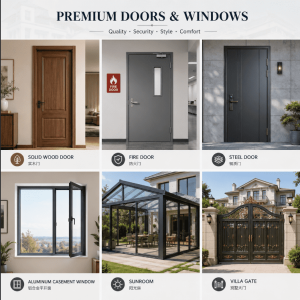
Our factory produces thermal-break aluminum doors and windows, solid wood doors, and custom villa entrances. We handle the full production process in-house, from profile cutting to glass assembly to hardware installation. This vertical integration allows full customization on size, color, glass configuration, and hardware accessories — without the constraints of a standard catalog.
Quality Assurance
Every order undergoes pre-shipment inspection testing air tightness, water tightness, and wind resistance. These are the same performance metrics discussed in Section 2 — we do not rely on component certifications alone. The finished door must perform to specification, not just the raw materials.
Our adjustable profile structures and fittings are engineered to match the local building codes of target markets. When you specify a wind load requirement for a coastal project or a thermal performance target for a cold climate, we can adjust the frame construction accordingly.
Export and Logistics
We handle the full export process: packing lists, proforma invoices, and complete customs documentation. Both FCL (Full Container Load) and LCL (Less than Container Load) shipments are available, with direct delivery from our factory to your warehouse or job site.
Partnership Models
We support OEM and ODM arrangements, including private labeling and design customization. For construction projects, we provide bulk supply with consistent quality across large orders — the scenario where factory-direct sourcing provides the greatest value.
Production Process: From Raw Material to Finished Door
Understanding the manufacturing process helps buyers evaluate supplier claims and anticipate quality issues.
Step 1: Profile Cutting and Machining. Aluminum profiles are cut to length, then machined with holes and slots for hardware installation. Precision at this stage determines how well the door assembles and seals.
Step 2: Thermal Break Assembly. For thermal-break profiles, polyamide strips are inserted between the interior and exterior aluminum sections. The assembly is crimped to ensure a permanent mechanical connection.
Step 3: Surface Treatment. Profiles undergo powder coating or anodizing. Powder coating offers a wider color range (RAL and custom colors) with good durability. Anodizing provides superior corrosion resistance but is limited to metallic finishes.
Step 4: Glass Preparation. Glass panes are cut, edged, and processed. Laminated glass undergoes autoclaving to bond the interlayer. Insulated glass units are assembled with Low-E coatings and gas fills in a controlled environment.
Step 5: Assembly. Frames are assembled, glass units are installed, and hardware is fitted. Multi-point locking systems are aligned and tested.
Step 6: Quality Testing. Finished doors undergo air tightness, water tightness, and wind load testing. Visual inspections check for surface defects, glass scratches, and hardware alignment.
Frequently Asked Questions
What is a glass door in front of a front door called?
That configuration is typically called a storm door or a security screen door. In modern architecture, it can also refer to a double door system where a glass outer door protects a solid inner door. A glass modern front door — the subject of this guide — is the primary entry door itself, not a secondary protective layer.
Is it okay to have a glass front door?
Yes, provided you use laminated glass for security and a thermal-break aluminum frame for insulation. Modern glass front doors are engineered with Low-E coatings and inert gas fills to achieve energy performance comparable to solid doors. For B2B projects, ensure the glass configuration meets local safety codes — most jurisdictions require tempered or laminated glass near door openings.
What is the most energy-efficient glass for a front door?
Triple glazing with two Low-E coatings and argon gas filling offers the highest thermal performance, achieving U-values below 0.8 W/m²K. For most climates, double glazing with a single Low-E coating is the industry standard for cost-effectiveness. The U-value metric matters more than the glass count — a well-sealed double-glazed unit outperforms a poorly sealed triple-glazed unit.
Can I customize the size and color of a glass modern front door?
Yes. Reputable manufacturers offer full customization on size, color (powder coating in RAL or custom colors), and glass configuration. For B2B buyers, the critical requirement is a supplier that can adjust profile structures to match your specific rough opening — not one that forces your framing to adapt to their standard sizes.
What is the typical lead time for a custom glass modern front door?
Custom-sized doors typically require 15–30 days for fabrication, plus 20–35 days for sea freight to most international destinations. Standard sizes with stocked profiles can ship faster. Factor in production scheduling — a manufacturer with high capacity utilization may have a queue that extends lead times.
References
- GB/T 7106-2019, “Graduations and test methods of air permeability, water penetration and wind load resistance for building external windows and doors,” Standardization Administration of China. https://www.gbstandards.org/GB_T_7106-2019.html
- National Fenestration Rating Council, “Understanding U-Factor and SHGC.” https://www.nfrc.org/window-types-for-energy-efficiency/
- Glass for Europe, “Low-E Glass: The Key to Energy Efficiency.” https://www.glassforeurope.com/
- International Code Council, “International Building Code — Glazing Requirements.” https://www.iccsafe.org/
—
Ready to spec a high-performance glass modern front door for your next development? https://doorwoodendoors.com/contact-us/“>Talk to our team to discuss your project’s specific wind load and thermal requirements.
https://doorwoodendoors.com/contact-us/” style=”display:inline-block;padding:12px 24px;background:#2563eb;color:#fff;text-decoration:none;border-radius:6px;font-weight:600″>Get a Free Quote