Content Menu
● 1. What Is a Farmhouse Style Door?
● 2. Why Farmhouse Doors Remain a Safe Specification
● 3. Materials Comparison: Solid Wood vs. Aluminum-Clad vs. Steel
● 4. Technical Specifications Every B2B Buyer Must Verify
● 5. How to Evaluate Farmhouse Door Suppliers
● 6. Production Process: From Raw Material to Finished Door
● 7. Customization and OEM/ODM Options
● 8. Ordering Process: MOQ, Lead Time, and Shipping
● 9. Quality Control: What a Multi-Stage Inspection Looks Like
8 min read
When a developer in Colorado orders 400 farmhouse-style entry doors for a suburban housing project, the conversation rarely starts with aesthetics. It starts with U-values, wind load ratings, and delivery windows. The design trend made the product popular; engineering makes it deliverable.
This guide covers what B2B buyers need to know before committing to a farmhouse door supplier — from material science to inspection protocols. If you are sourcing for a single custom build, this may be more than you need. If you are procuring for a development, a hospitality project, or a distribution line, the details below will save you from costly specification errors.
What Is a Farmhouse Style Door?
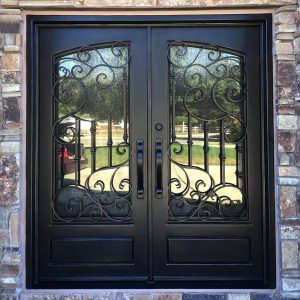
A farmhouse style door blends rustic, barn-inspired elements — X-bracing, board-and-batten panels, arched tops — with modern hardware and glass configurations. The defining characteristic is the balance between sturdy, simple forms and contemporary performance requirements like thermal insulation and multi-point locking.
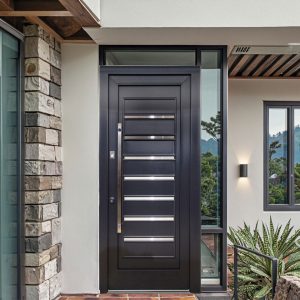
The category splits into two functional groups: interior doors (typically sliding barn doors or panel designs) and exterior entry doors (often full-lite glass units with black aluminum frames). Exterior units demand significantly more engineering attention.
Why Farmhouse Doors Remain a Safe Specification
The modern farmhouse aesthetic has moved past its “fixer-upper” phase. Current iterations favor clean lines, neutral palettes, and natural materials — which pair well with brick, stucco, wood siding, and metal panel cladding. This versatility explains its staying power across North America, Australia, and parts of Europe.
For developers, the trend offers a practical advantage: farmhouse doors do not lock a project into a narrow visual identity. They work in coastal homes, mountain retreats, suburban infill, and even urban townhouses. That flexibility reduces the risk of a design becoming dated before construction completes.
Color Guidance for Specifiers
Design guidance on front door colors is often presented as hard rules. The reality is more nuanced. Common recommendations avoid:
- Pure white — can appear washed out against bright siding or heavy sun exposure.
- Black in harsh sun climates — absorbs heat, which can warp certain materials and fade finishes faster.
- Red — clashes with the natural wood and neutral tones typical of farmhouse palettes.
Neutral tones — greige, charcoal, sage — currently dominate specifications. Black remains the top choice for contrast, but only with materials rated for UV exposure.
Materials Comparison: Solid Wood vs. Aluminum-Clad vs. Steel
The material decision dictates cost, maintenance, thermal performance, and lifespan. There is no universal “best” — only the right match for your climate and project type.
| Material | Best For | Thermal Performance | Maintenance | Relative Cost |
|---|---|---|---|---|
| Solid Wood (Alder, Oak, Mahogany) | Interior doors, high-end exterior | Good with proper sealing | High — refinishing required | High |
| Thermal-Break Aluminum | Exterior doors, coastal, extreme climates | Excellent — meets strict energy codes | Low | Medium-High |
| Steel | Budget bulk projects | Moderate — thermal bridging risk | Medium — denting and rust potential | Low-Medium |
| Fiberglass | Budget exterior, high humidity | Good | Low | Medium |
Imperfect insight: Solid wood doors are not always the right choice for exterior applications. In high-humidity or direct-sun environments, the wood movement — expansion, contraction, warping — creates warranty issues that aluminum-clad units simply do not have. Buyers should prioritize moisture and UV resistance over the premium look of natural timber when the project site demands it.
Technical Specifications Every B2B Buyer Must Verify
Aesthetic compliance means nothing if the door fails the building inspection. These are the performance parameters to specify and verify.
Thermal Performance
Exterior door U-factor requirements vary by climate zone. In North America, ENERGY STAR® zones set specific maximum U-factors; the EU uses EN ISO 10077 for calculation. Thermal-break aluminum frames with insulated glass units (IGUs) are the standard solution for meeting strict codes. Look for:
- Multi-chamber frame profiles
- Polyamide thermal break strips (typically 24–34 mm)
- Low-E glass coatings with argon gas fill
- U-factor ratings below 1.0 W/m²K for cold climates
Air and Water Tightness
The relevant test standards are EN 12207 (air permeability) and EN 12208 (water tightness). For residential projects, Class 4 air-tightness and Class 7A–9A water tightness are typical minimums. Commercial projects in exposed locations may require higher classifications.
Wind Load and Impact Resistance
In high-velocity hurricane zones (HVHZ), doors must meet ASTM E330 structural performance standards and, in some jurisdictions, TAS 201/202 impact protocols. The frame structure — not the door skin — carries the load. Reinforced steel inserts inside aluminum profiles and heavier hinge reinforcement are what pass these tests.
Hardware and Glass
- Multi-point locking systems — at least 3-point for exterior doors
- Hinges — stainless steel or marine-grade for coastal environments
- Glass — tempered or laminated; laminated provides better security and sound insulation
How to Evaluate Farmhouse Door Suppliers
The evaluation framework below applies to any factory, anywhere. Use it before you send a deposit.
Step 1: Verify Performance Test Reports
Ask for third-party test reports for the specific door model you intend to order. Reports should include air permeability, water tightness, and wind load resistance. If the factory only provides “certificates” without test data, treat it as a red flag.
Step 2: Assess Customization Capability
Farmhouse doors are rarely ordered in standard sizes. Confirm the factory can adjust:
- Overall dimensions (width, height, jamb depth)
- Glass configurations (divided lites, full lites, obscure glass)
- Hardware finishes and lock types
- Color matching (including custom RAL or wood grain finishes)
Step 3: Visit or Video-Verify the Production Line
A video call through the workshop tells you more than a brochure. Look for organized material storage, clean welding stations, and finished goods being wrapped for shipping. Ask to see the inspection area.
Step 4: Check Export Experience
Suppliers who regularly export know the documentation requirements: packing lists, proforma invoices, bills of lading, and certificates of origin. They also understand how to package doors to survive ocean freight — this is where many factories fail.
Red Flags to Avoid
- No test reports available or “available after order”
- MOQ requirements that seem designed to offload slow-moving stock
- Unable to explain how they handle customs documentation
- No clear pre-shipment inspection process
- Pricing that is significantly below market — you will pay for it in rework
Decision Guide
- Choose a trading company if you need a wide product range from multiple factories and order small volumes.
- Choose a direct factory if you need consistent quality, custom specifications, and competitive pricing at scale.
Production Process: From Raw Material to Finished Door
Understanding the production steps helps buyers identify where quality is won or lost.
For thermal-break aluminum doors:
- Profile extrusion — aluminum billets are heated and extruded into the required profile shapes.
- Surface treatment — anodizing or powder coating (typically 60–80 microns) for corrosion resistance.
- Thermal break insertion — polyamide strips are inserted and crimped to separate interior and exterior aluminum sections.
- Cutting and machining — profiles are cut to spec, with drainage holes and hardware slots machined.
- Assembly — frames are assembled, glass is fitted with structural sealant, and hardware is installed.
- Quality inspection — air, water, and wind tests are performed on sample units.
- Packaging — doors are wrapped with protective film, foam corners, and wooden crates for export.
For solid wood doors:
- Kiln drying — lumber is dried to 8–12% moisture content to prevent warping.
- Frame construction — stiles and rails are joined, often with finger-jointed core for stability.
- Panel fitting — raised or flat panels are fitted into the frame.
- Sanding and finishing — multiple sanding passes followed by primer and paint or stain.
- Hardware installation — hinges, locks, and decorative elements.
- Final inspection — checking dimensions, finish consistency, and hardware function.
Customization and OEM/ODM Options
B2B buyers have three partnership models to consider.
OEM (Original Equipment Manufacturing)
You provide the specifications — dimensions, glass, hardware, performance requirements. The factory manufactures to your exact drawings. This suits developers with in-house design teams and distributors with established product lines.
ODM (Original Design Manufacturing)
The factory offers existing farmhouse door designs that can be modified — color, glass, hardware. This is faster and typically has lower tooling costs, making it suitable for first-time importers testing the market.
Private Label
The factory manufactures to your branded specifications, with your logo and packaging. This requires a trusted supplier and clear quality agreements.
Ordering Process: MOQ, Lead Time, and Shipping
Understanding the commercial terms prevents surprises.
Minimum Order Quantity (MOQ)
MOQs vary by material and supplier. For aluminum farmhouse doors, a 20-foot container (FCL) typically holds 40–60 doors depending on size. Some factories accommodate LCL (less than container load) shipments for pilot orders of 5–10 units.
Lead Times
- Standard production: 15–30 days
- Custom OEM orders: 30–45 days (includes drawing approval and tooling)
- Sea freight: 20–40 days depending on destination port
Shipping Documents
A reliable supplier provides:
- Packing list
- Proforma invoice
- Bill of lading
- Certificate of origin
- Any destination-specific customs documentation
Quality Control: What a Multi-Stage Inspection Looks Like
Professional factories inspect at multiple points, not just before shipping.
- Incoming materials — aluminum profiles are checked for coating thickness; wood is checked for moisture content.
- In-process inspection — welding seams, corner joints, and glass installation are checked during assembly.
- Pre-shipment inspection — sample units undergo air-tightness, water-tightness, and wind resistance tests. All units are checked for cosmetic defects, hardware function, and packaging integrity.
Buyers should request photos or video of the pre-shipment inspection, or hire a third-party inspector for large orders.
How We Meet These Standards as a Factory Supplier
The sourcing framework above describes the industry baseline. As a manufacturer of farmhouse doors and windows, our approach aligns with those expectations.
Direct Factory Supply
We manufacture doors and windows in our own facility and sell directly to buyers. There is no trading company layer adding 15–30% markup. Our pricing reflects material, labor, and logistics — nothing else.
Full Customization
We offer OEM and ODM services covering size, color, glass configuration, and hardware accessories. Our team works from your architectural drawings to ensure dimensional and performance compliance.
Pre-Shipment Testing
Every batch is tested for air-tightness, water-tightness, and wind resistance before leaving the factory. Test reports are available on request.
Export Documentation and Logistics
We handle the full export process: packing lists, proforma invoices, and customs clearance documents. We ship via FCL or LCL directly from our factory, with packaging designed for ocean freight.
Compliance Adjustment
Our profile structures and fittings can be adjusted to match local building codes in your target market. This includes thermal performance requirements and wind load standards.
If you are sourcing farmhouse doors for a project or distribution line, the practical question is whether the factory can meet your specifications, timeline, and quality bar. That is what we are set up to answer.
References
- ENERGY STAR®. Window and Door U-Factor Requirements by Climate Zone. https://www.energystar.gov/products/windows_doors
- European Committee for Standardization. EN 12207:2016 – Windows and doors – Air permeability – Classification. https://www.en-standard.eu
- ASTM International. ASTM E330 – Standard Test Method for Structural Performance of Exterior Windows, Doors, Skylights and Curtain Walls by Uniform Static Air Pressure Difference. https://www.astm.org/e0330-14.html
- ASTM International. ASTM E283 – Standard Test Method for Determining Rate of Air Leakage Through Exterior Windows, Skylights, and Doors. https://www.astm.org/e0283-19.html
- Florida Building Commission. TAS 201, 202, 203 – Impact Test Procedures for HVHZ. https://www.floridabuilding.org